
Mostar: Bridges, Bullet Holes & Balkan Hospitality
I arrived in Mostar after a winding 3.5‑hour bus ride from Dubrovnik – a short distance on the map, but in reality takes forever thanks to the hills separating Bosnia from Croatia. From the bus station I texted my Couchsurfing host, Gogi, and minutes later we met in a garage car park like two men doing a dodgy deal.
Gogi drove me to his flat on the outskirts of town, ordered pizza, handed me beers, and we spent the evening chatting about life in Bosnia, life in the UK, and life in general. Neither of us had the energy to go out, so we called it a night.
The next morning, he drove me into town for breakfast – spinach pies and coffee at Sadrvan, a pretty little café in the centre. After booking my return bus to Dubrovnik, Gogi headed off and I explored Mostar solo.
Mostar is a gorgeous maze of cobbled lanes, Ottoman architecture and riverside views.
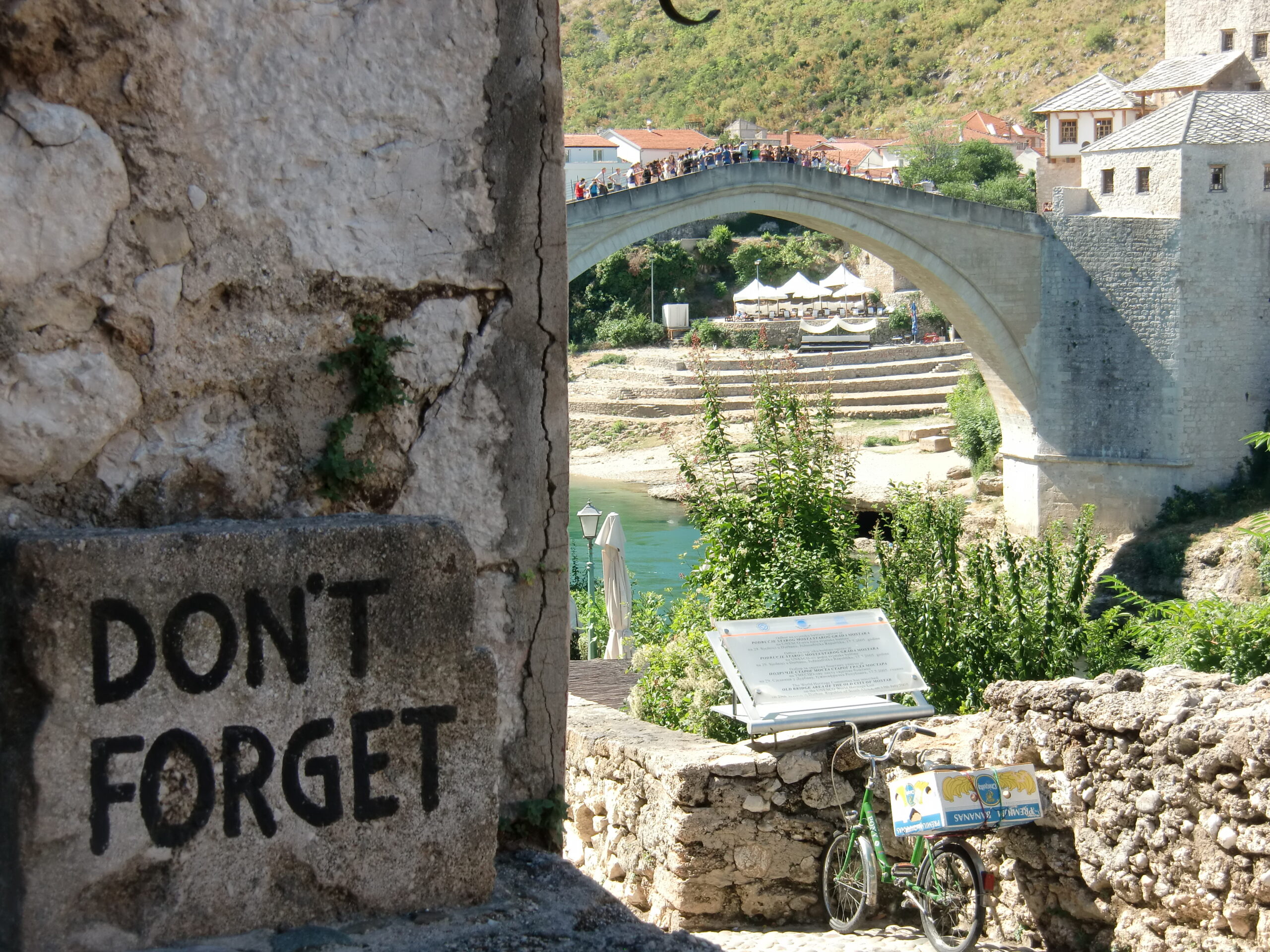
The star of the show of the town is the famous Stari Most – where the town gets its name – meaning Old Bridge.
The stone bridge, originally built to replace a rickety old wooden bridge was built in 1566 with stone from the local limestone quarry, needed to keep up with the increasing demand in trade in the growing town, connecting the two sides of the fast flowing river Neretva.
It lasted 427 years.
Until it was blown up in 1993 in the Balkan War.
In 2004 it re-opened, having been rebuilt in-part with the original blocks but also built in line with the old design and more stone from the same quarry.
The destruction and rebuild gained international attention, hence the famous status of the bridge.
A nearby free photo exhibition about the bridge, including video footage of its destruction during the Balkan War was a sobering watch.
I wandered through the old streets, climbed the minaret at Koski Mehmed Pasha Mosque for panoramic views of the river, bridge and the surrounding hills.
Further along the river is the Crooked Bridge – no surprises this one isn’t so straight.
Further along the river is Tito’s Bridge, and then eventually I walked along what used to be the front line of the Balkan War.
Further out, abandoned buildings still riddled with bullet holes stood as grim reminders of the war.
In all, it was a wonderful little, old town oozing character with a super chilled vibe and friendly locals, despite it’s horrific past. Who would’ve thought a bridge would tell so many stories.

Montenegro: Kotor’s Fjord & The Hostel That Was Actually a Restaurant
I caught the bus back to Dubrovnik, then connected onto a early evening bus to Kotor in Montenegro. The ride was spectacular – deep blue sea, dramatic mountains, tiny towns clinging to the coastline.
As the sun set, the scenery faded into darkness and we rolled into Kotor after 3¼ hours.
Immediately, locals swarmed me offering homestays, but I already had a booking at the “Montenegro Hostel” in the old town. Finding it was another matter. The old town is a medieval maze, and after circling the same square twice, I asked a restaurant for directions.
Turns out the restaurant was the hostel. A guy appeared, told me to follow him, and led me to a separate building five minutes away. Turned out to be 24 euros a night plus 5 euros to use the shower the next day. Pretty extortionate for this part of the world, and why not just charge 29 euros? I know I was a backpacker but I still wanted a shower! Balkan logic.
I dropped my bag and wandered the old town – lively, atmospheric, and packed with tourists.

Kotor Fortress: Sweat, Views & Fjord Glory
I woke early to hike up to Kotor Fortress before the heat kicked in.
Kotor Fortress sits 260m above sea-level – built over centuries, between the 15th and 17th, in order to secure and protect the strategic location of the town and its control over the Adriatic Sea.
The climb was steep, sweaty and relentless, but the views were unreal – the fjord stretching out like a Norwegian postcard, mountains rising dramatically on all sides. Easily one of the most stunning natural sights in Europe.
After descending, I found a tiny lakeside beach and café, grabbed a tea, and recovered from my morning workout. Lunch was a cheap salad at Kantun cafe in Maritime Square, before I headed to the bus station for my next leg: Podgorica, Montenegro’s capital.
Podgorica: The Dullest Capital in Europe & the start of a 22-hour bus marathon
The bus to Podgorica took two hours. I dropped my bag at left luggage and went exploring – and I can confidently say Podgorica is the dullest capital city I’ve ever visited. Nothing to see, nothing to do, nothing to photograph. I lasted about 20 minutes before retreating back to the station.
With a few hours to kill until my bus, I parked myself in a nearby café and people watched. By the time night had fallen, it was time for my night-bus to Prishtina, Kosovo’s capital.
The Worst Bus Ride Ever
The 8-hour overnight bus to Prishtina was pure torture.
First, the rickety old bus was totally overbooked – probably by about 50%.
There were 3 people crammed onto two seats.
Those that couldn’t manage that, slept in the aisle.
I had two kids sleeping at my feet, even though I was sat at a window seat.
This meant I had to have my backpack on my lap.
But I also had the knees of a 5-year-old digging into my ribs as he tried to sleep on his grandma’s lap next to me.
There was no aircon and it was stifling hot.
The music blared out all night from the speakers and if anyone needed the toilet – tough – the door was locked and there were no stops.
I tried speaking broken Russian to the grandma, but it was pretty hopeless.
The journey felt endless, but eventually – at 5am – we arrived in Prishtina.

Kosovo → Macedonia → Bulgaria
But I was on a tight schedule to get to the Bulgarian coast for a wedding and the only bus of the day heading in the direction that I needed, was leaving to Skopje immediately. I had no choice but to jump on and completely miss taking on Kosovo’s capital.
Two hours later we arrived, and I had just enough time for a brief wander around the city before catching another bus – to Sofia, Bulgaria’s capital.
The Sofia bus took 5¼ hours. Once there, I waited another hour before boarding a final bus to Sunny Beach, on Bulgaria’s Black Sea coast. I arrived just after midnight – exhausted, I grabbed a taxi to my apartment.
Four countries, three buses, 22 hours. Utter madness.

Bulgaria: An Aussie / Bulgarian wedding, Fortresses & Communist monuments
The wedding of my Aussie mate and his Bulgarian wife was two hours up the road in Varna.
As most guests were coming in from many parts of the world at different times, it meant the stag do could only happen the day before the wedding. Just like the old days. A bunch of Aussies on a stag do in Bulgaria, where a beer costs the equivalent of USD$0.60, what could possibly go wrong. To be fair, I have no idea, as I don’t remember much.
The wedding went off without a hitch, and it was back to Sunny Beach, grab a hire car and explore eastern Bulgaria for a few days before finally chilling on the beach.
After a brief stop in the pleasant city of Burgas, it was on to Veliko Tarnovo – a beautiful historic town with a massive fortress overlooking the valley. Hostel Mostel was a cracking choice of accommodation for the night with awesome free meals included. At night there was a light show at the fortress, which was pretty impressive before few beers in town were enough to send me to sleep.
The next day, there were a number of other places visit:
- Arbanasi – a lovely small town with beautiful old crumbling ornate churches
- Tryavna, a charming little town with cobbled streets and an old arched bridge
- Shipka to visit the imposing Freedom Monument, built in 1934, stood 31 meters tall, after a painful 890 steps to reach it, resembling a medieval fortress, signifying the defence of the area against the Ottomons in the late 1800’s.
- The surreal Buzludzha Monument – a giant abandoned communist party structure resembling a UFO on a mountaintop
Back in Sunny Beach, the road rip ended, and all that was left was to put my feet up a relax by the pool and beach for several days to recuperate after such a mammoth but hugely rewarding trip across the fascinating Balkans, one of my favourite parts of Europe.
It was not to be my last visit to the region.

You Might Also Like
Read more of our blogs from around the world

Read out travel guides from various places around the world