Chiang Mai’s Old City
Chiang Mai is Northern Thailand’s cultural heartbeat.
A small city with a patchwork of history dating back to its founding by the Lanna Kingdom in the 13th century. Burmese rule, periods of abandonment and eventual revival all helped shape the city that exists today; a place rich in culture, history, cafés and enough spas to bankrupt anyone travelling on a backpacker’s budget.
The Old City is the centrepiece. Covering just 2.5 square kilometres, it was once a square-shaped brick-walled settlement surrounded by a moat, with only four gates providing access.
Today, only fragments of the original walls remain and most of the gates have been rebuilt. Modern Chiang Mai sprawls far beyond those original boundaries, but the old quarter still forms the city’s historic heart.
Yet for many visitors, it is what surrounds Chiang Mai that provides the biggest draw.
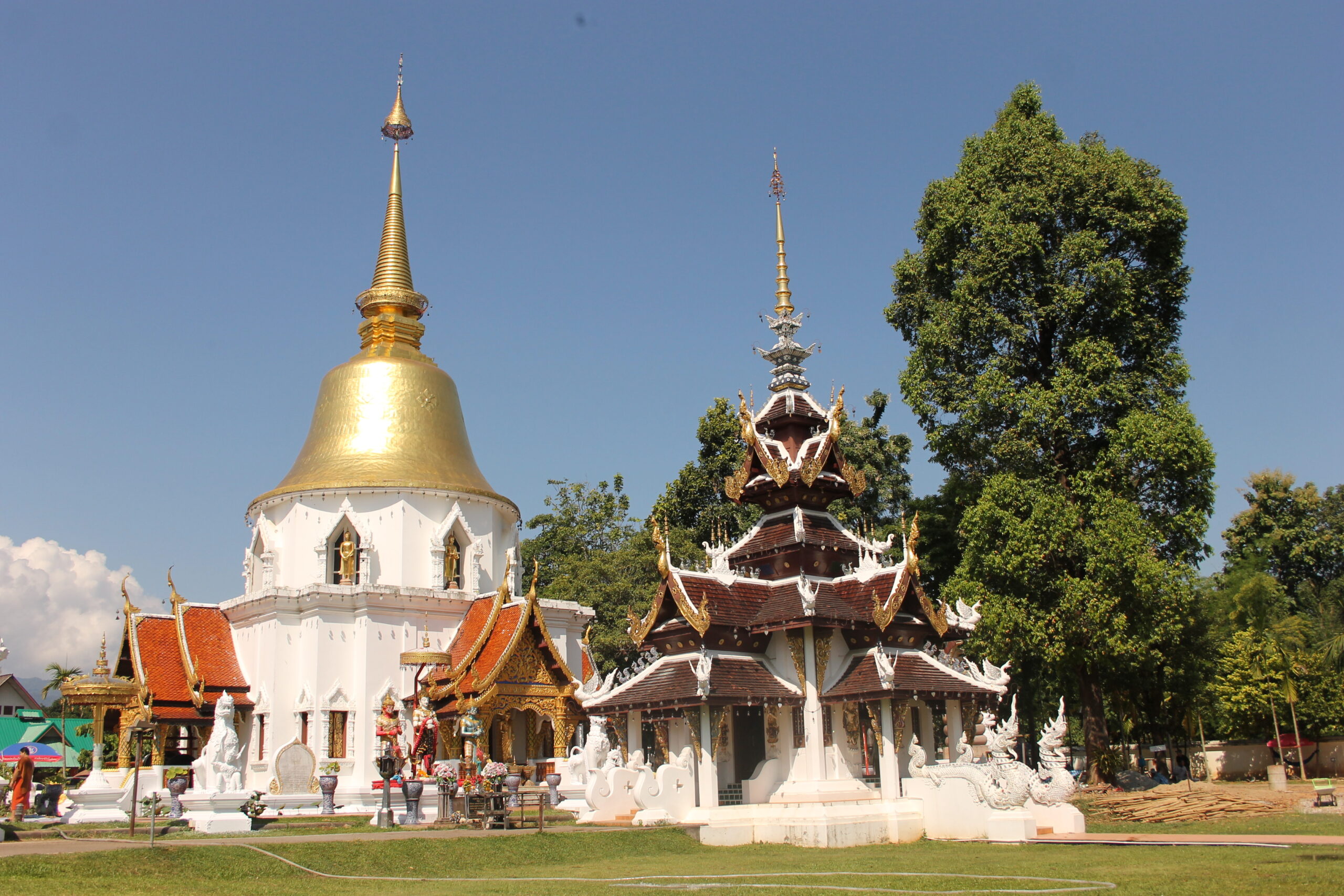
The city sits amongst forested mountain ranges dotted with tiny villages, endless waterfalls, hiking trails, elephant sanctuaries, meditation retreats and wellness resorts boasting the sort of views that make you briefly consider becoming a different person. There are also countless Buddhist temples. In fact, there are so many that temple fatigue becomes a genuine medical condition. Well, it should be.
Hiring a Car in Chiang Mai – the way to go
Most of these attractions are spread across a huge area, and once again we found that having a car made an enormous difference.
After spending a week exploring the Old City and nearby attractions by taxi, we hired a car and spent the next couple of weeks discovering the wider region at our own pace.
And that decision totally enhanced the whole experience.
Cafés: Carp, Crafts & Cats
Around the Old City it feels like every second business is either a quirky café or a spa.
Since our budget doesn’t quite extend to daily luxury spa treatments, we focused heavily on the café scene. It seemed the financially responsible thing to do.
The Carp Café
First up was The Carp Café.
The concept is brilliantly simple. Tables are sunken into a giant koi pond, separated from the fish by a low protective wall. The result is hundreds of enormous koi swimming just inches from your table.
Buy some fish food, throw it in and an instant feeding frenzy erupts directly beneath your lunch.
The kids absolutely loved it.
Ginger Farm Café
Next came Ginger Farm Café, an organic farm, petting zoo and arts & crafts café all rolled into one.
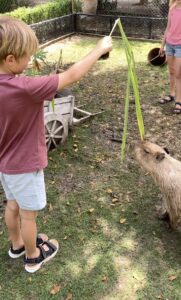
The kids fed rabbits, wandered through the gardens and produced various artistic masterpieces of questionable quality while we enjoyed some excellent food.
The whole place had a lovely relaxed atmosphere and was one of our favourite family-friendly spots in Chiang Mai.
Por Puh Cat Café
Finally, there was Por Puh Cat Café.
We’ve visited a few animal cafés during this trip, but this was our first dedicated cat café. The cats appeared well cared for and the kids happily spent an hour playing with their new furry friends.
Climbing the Sticky Waterfall
Buatong Waterfall, better known as the Sticky Waterfall, is one of Chiang Mai’s most famous attractions.
Located within Chet Si Fountain National Park, the waterfall flows over limestone rock infused with calcium carbonate from an underground spring. The result is a remarkably grippy surface that allows visitors to walk directly up the waterfall against the flowing water.
It’s an incredibly strange feeling.
Your brain is screaming that this should be slippery, yet your feet seem glued to the rock.
The waterfall consists of four tiers and climbing it barefoot is surprisingly easy. The kids loved it so much they immediately ran back down the steps and climbed it all over again.
I wasn’t far behind.
Even more impressive: it was completely free.
The Jungle Coaster
Located in the hills northwest of Chiang Mai, The Jungle Coaster is part of an adventure park offering ziplining, giant swings, jungle bikes and various other activities designed to separate tourists from their money.
The main attraction is the Jungle Coaster itself.
Think somewhere between a luge and a roller coaster.
You ride in an open rail car, either solo or with a passenger, controlling your speed using a handbrake.
Naturally, the handbrake was treated more as a theoretical concept.
At full speed it was brilliant fun, with the kids and I laughing our heads off all the way around.
Chiang Mai Sunday Night Market
Chiang Mai is blessed with plenty of markets.
Most are fairly “same same”, selling Chang and Singha singlets, fridge magnets and the usual souvenir collection. But Sunday Night Market on Ratchadamnoen Road is in a different league.
Every Sunday, the market takes over several streets of the Old City, covering more than a square kilometre and featuring hundreds of stalls selling handmade crafts, clothing, artwork, gifts and enough fresh fruit smoothies to keep a small army hydrated.
If you’re looking for something a little different, this is the place.
You need hours to do it properly.
Sadly, our increasingly tired children did not share this view. We managed roughly a third of the market in a couple of hours before surrendering.
At least we escaped with a couple of souvenirs and several outstanding watermelon shakes.
Learning to Cook Thai Food
We all love Thai food, so before leaving Thailand we couldn’t pass up the chance to learn how to cook it properly. A three-hour family cooking course seemed like a much better souvenir than another fridge magnet.
The experience started with a trip to the local market to buy ingredients, which was an education in itself. Back at the kitchen, we got straight to work, somehow managing to cook five dishes in just two hours. Better still, they all tasted amazing.
The number of herbs and spices that go into Thai cooking is mind-boggling, but they’re clearly the secret behind those incredible flavours. The kids absolutely loved the experience and were asking when we could do another class. At least now they can no longer claim they don’t know how to help with dinner when we get home.
A Northern Thailand Road Trip
Towards the end of our stay, we decided to take a short road trip through Northern Thailand.
While the area north of Chiang Mai looked incredible, we opted to head east and then south, venturing a little further off the well-worn tourist trail.
Mae Kampong
Mae Kampong is a tiny mountain village east of Chiang Mai.
Nestled in a narrow, forested valley, a stream runs through the centre while wooden restaurants and souvenir shops cling to the hillside alongside the road.
It is undeniably touristy, but it still manages to feel peaceful and authentic.
The cooler mountain air was a welcome break from the heat below.
The kids, however, remained unimpressed.
Only the promise of ice cream convinced them to continue long enough for us to visit the nearby waterfall.
Lampang
About two hours south of Chiang Mai lies Lampang, a city of around 250,000 people.
Known for its horse-drawn carriages and beautiful temples, it was impossible not to stop, particularly with Sofia’s ongoing enthusiasm for anything horse-related.
We stayed at a Lampang River Retreat outside the city. Wooden villas surrounded a lake filled with lily pads, while an infinity pool overlooked tropical gardens bursting with flowers.
Breakfast was served overlooking the river.
The accommodation itself wasn’t quite as luxurious as the grand entrance suggested, but the peaceful setting more than made up for it.
At least until our two children discovered the swimming pool.
Becoming Local Celebrities in remote Thailand
Our next stop was an organic herb garden in the Sukhothai district, around four hours south of Chiang Mai.
A friend of a friend had invited us to stay, and our host took Sofia and me to a small local market nearby.
We immediately became celebrities.
This was clearly somewhere very few foreigners ever visit, and we attracted attention everywhere we went.
People stared.
The braver locals approached for photos.
Sofia’s blonde hair generated particular fascination.
Then things escalated.
One stallholder appeared to be operating as both vendor and DJ, providing a running commentary over loudspeakers. The moment she spotted us, we were ushered into photographs while announcements blasted across the market.
The only words I consistently recognised were “New Zealand”.
As we eventually left, locals stood watching and waving as our car disappeared into the distance.
It felt like we’d accidentally become the headline act at the village’s biggest event of the week.
This felt like the real Thailand.
Not the polished tourist version.
I loved it.
The kids were mostly confused.
The Giant Centipede Incident
That night, sleeping on a mattress on the floor, I was abruptly woken at 6am by a searing pain in my right hand.
I launched out of bed screaming.
Immediately I knew something had stung or bitten me, but with spiders, snakes, scorpions and giant centipedes all living nearby, I had absolutely no idea what the culprit was.
Two puncture marks were visible on my hand as waves of pain shot through my arm.
After moving the kids somewhere safe, the hunt began.
Ten minutes later, after carefully lifting bags, clothing and bedding, we found the offender hiding beneath a pillow.
A giant Scolopendra centipede.
These things are terrifyingly fast.
Within seconds it had vanished into my backpack.
After dragging the bag outside and emptying everything onto the ground, we finally managed to corner it and launch it back into the surrounding bush.
Scolopendra are feared throughout Thailand.
These giant centipedes are over 20cm long and can exceed 30cm, armed with venomous pincers and a thoroughly unpleasant attitude.
They’re basically the final boss of the insect world.
Fortunately, once we identified the culprit, I relaxed slightly.
The sting is rarely dangerous unless an allergic reaction occurs.
I was mostly relieved that it had chosen me rather than one of the kids.
As for the pain?
Imagine a bee sting.
Now imagine five bee stings.
Now imagine somebody hammering a nail through your hand at the same time.
That felt about right.
My hand swelled slightly, I developed hives along my arm and absolutely nothing helped the pain.
Ice didn’t work.
Painkillers didn’t work.
Various herbal remedies didn’t work.
My hand simply throbbed for hours.
Thankfully, by that evening the pain began to ease, and by the following morning I was completely back to normal.
Considering some reports suggested the pain can last up to five days, I suspect I got off lightly.
Thailand’s First Capital - Sukhothai
Sukhothai was Thailand’s first capital after breaking free from the Khmer Empire around 1300, ruling over a kingdom that wasn’t too different in size and shape to modern-day Thailand.
Today, its ancient brick ruins offer a glimpse into the birthplace of Thai culture. Spread across more than 29,000 acres, the UNESCO World Heritage Site is dotted with temples, Buddha statues and crumbling structures dating back to the 13th century. In places, it felt a little like a miniature Angkor Wat, only without the crowds.
With time against us, we hired a golf cart and driver to whisk us around some of the highlights. But it felt like speed-dating a UNESCO site as we hopped on and off the cart to see as much as we could before dark; enough to leave a strong impression, but nowhere near enough time to truly get to know it.
As the sun began to set over the ancient temples, casting a golden glow across the ruins, we caught a brief but memorable glimpse of one of Thailand’s most important historical treasures. It’s definitely a place that deserves a return visit, with more time, one day.
Doi Inthanon National Park
Our final stop was a small property called Farinda Resort & Pool.
With only three rooms and a swimming pool located directly outside the doors, it was exactly the sort of place we needed, to not do too much.
We did venture into Doi Inthanon National Park, home to Thailand’s highest mountain, waterfalls, temples and indigenous hill tribe communities.
Driving to the summit at 2,565 metres, we climbed into the clouds as rain rolled in.
The temperature plunged from 35°C to around 15°C, and for the first time since leaving Japan we found ourselves reaching for extra layers.
The views were spectacular.
Google Maps, unfortunately, was not.
A navigational error sent us the wrong way to our chosen waterfall and, with increasingly cranky children in tow, we never actually reached it.
In fairness, I think the kids had officially reached maximum waterfall capacity by this stage of the trip anyway.
Farewell Northern Thailand
And so our adventure through Northern Thailand has come to an end.
Next stop: Koh Samui for the final chapter of this mammoth journey.
Travel fatigue has started creeping in once again and, before long, we’ll be back home in New Zealand for what feels like a well-earned rest.
Northern Thailand brought something completely different to our experience of the country – and I have truly loved it.
We discovered local communities, sampled new foods, drove some spectacular mountain roads and saw a side of Thailand that many visitors never experience.
There’s still so much more we would love to explore here, but that’ll have to wait for another trip.
Although if anyone mentions another temple or waterfall in front of the kids, I suspect they’ll immediately down tools, and declare this trip prematurely over.