
At a Glance
- Visited: March 2026 · 5 days · First visit
- Location: Kanto region, eastern Japan – Honshu island
- Best time to visit: March to May (cherry blossom, mild temperatures) or September to November (autumn colours, cooler)
- How long to stay: 5-7 days minimum – Tokyo is vast and rewards time
- Best for: Families who love culture, food, technology and urban adventure
- Budget (family of 4): Expect 40,000-50,000 Yen per day (USD$250-300) -Tokyo is expensive
- Getting there: Narita or Haneda airports – both well connected globally or Shinkansen (bullet) train from other Japanese cities
- Getting around: Metro is extensive and efficient – buy IC cards (Suica or Pasmo) on arrival
- Best area to stay: Shinjuku or Shibuya for central access – we stayed in a quieter suburb around Kinshicho station, which was gave us a very local feel
- Family friendly rating: 8/10 – extraordinary but exhausting. We found the crowds and the metro exhausting but were rewarded with a cultural injection like no other
Tokyo is the largest city on earth – nearly 40 million people packed into a sprawling, jaw-dropping, neon jungle with spotless streets, and technology so advanced it has solved problems we never knew existed.
We arrived tired after a six-hour flight from Kuala Lumpur but were soon slapped in the face by six degrees of cold air. After months of sticky Southeast Asia, the shock was physical. Tokyo, it turned out, was about to deliver quite a few more of those.
Five days. Kids aged nine and seven. One Samurai Museum. One disastrous SkyTree evening. And the most sophisticated toilet system any of us had ever encountered.
This is our honest guide to Tokyo with kids.
In This Article:
- What is Tokyo like for families?
- When to visit Tokyo with kids
- Getting to Tokyo
- Getting around Tokyo with kids — the metro survival guide
- Where to stay in Tokyo with kids
- Where to eat in Tokyo with kids
- Things to do in Tokyo with kids
- The Japan toilet situation — an important section
- Tips for Tokyo with kids
- Costs and budget
- Is Tokyo worth it for families?
- Frequently asked questions
What is Tokyo Like for Families?
Tokyo is extraordinary and exhausting in roughly equal measure.
It is the largest city in the world, and it feels like it. The scale is almost incomprehensible. Arriving from Southeast Asia where we’d been for months, the contrast hit us immediately: cooler, quieter, cleaner, more ordered, and considerably more expensive.
Japan runs on rules. Rules for walking. Rules for queuing. Rules for how you board a train, where you stand on an escalator, what you do with your litter. This is either refreshing or challenging depending on your disposition – and considerably more challenging when travelling with two children who treat rules as suggestions. Our kids had evolved by Tokyo into what we called ‘the monkeys’ – swinging from metro handrails, sitting on the floor of packed carriages, arguing loudly on escalators. Quietly, we just kept moving.
But beneath the chaos of navigating a 40-million-person city with two kids, Tokyo delivered moments of genuine wonder at almost every turn. Every corner was a wow-moment – a collision of futuristic and traditional, Western and utterly alien. Whilst it nearly broke us at times, it left us with memories for a lifetime.
Our honest take: Tokyo is brilliant but humbling. Go with realistic expectations about the metro, the cost, the business and your energy levels. Five days was the right amount for us, maybe we could’ve stretched an extra few days but it was enough to scratch the surface without burning out completely.
🐘 Wondering what a 9-year-old actually thinks about Japan? Read her review in our Kids Corner – click here
When to Visit Tokyo with Kids
Spring (March to May) – Most Popular
Cherry blossom season in late March to early April transforms Tokyo into something genuinely magical. Parks fill with blossoms and picnicking families. Mild temperatures make sightseeing comfortable. The downside: everyone in the world wants to be here at the same time. Book accommodation months in advance. We arrived mid-March and was surprised at how chilly it was but most days were sunny.
Autumn (September to November) – Our Recommendation
Autumn colours are meant to be spectacular, temperatures are pleasant (15-20 degrees), and the crowds are more manageable than spring / cherry blossum. September can still be warm and humid – October and November are the sweet spot.
Summer (June to August) – Avoid with Young Kids
Tokyo in summer is allegedly brutally hot and humid – regularly 35 degrees with high humidity. Combined with the metro crowds and distances involved, I would imagine it would make family sightseeing less fun.
Winter (December to February) – Coldest
Cold. Clear skies and less crowded attractions make it manageable, but pack properly. I would imagine despite the cold, it would be a very pretty time to visit.
Getting to Tokyo
By Air
Tokyo has two main airports – Narita (further from the city, around 60-90 minutes) and Haneda (closer, around 30-40 minutes). Most international long-haul flights use Narita; Haneda handles more domestic and regional routes. We flew in from Kuala Lumpur into Haneda.
We found immigration challenging at Haneda – very disorganised, in fact complete chaos. For a country that has a reputation for being so well organised, we were quite shocked and the struggles we had. Just be prepared if kids are hungry and cranky.
From Narita, the Narita Express (N’EX) train is the most comfortable option into the city. From Haneda, the monorail or Keikyu train are quick and efficient. However, being first timers, travelling with tired kids, we pre-booked a taxi via Booking.com. This worked well with good communication via WhatsApp to the meeting point.
Book flights to Tokyo here.
By Train
From Osaka the bullet train (Shinkansen) takes around 2 and a half hours – depending on which one you get, it could be slightly more. Kyoto is just 15 minutes less.
Book train tickets within Japan here.
Getting Around Tokyo with Kids - The Metro Survival Guide
The Tokyo Metro is arguably the most comprehensive urban rail network in the world. It is also, for the uninitiated, genuinely bewildering.
Just getting to the metro felt like a military operation. By the time we reached any destination, we were already exhausted and slightly defeated, knowing we had to do the whole journey again in reverse. Unlike Southeast Asia, taxis are not a budget-friendly option in Tokyo – the metro is the only practical way to get around.
We did do a lot of walking where we could, between sights, just to soak up more of the culture, the city, the people. Not always easy with kids, but some days we done 45-minute walks, and the kids just about survived.
IC Cards – Get These First
Buy a Suica or Pasmo IC card at any station on arrival. Load it with yen and tap in and out at every journey. Works on all metro lines, many buses, and even in convenience stores. Without one you may have to queue for tickets each time and pay more. They do cards for kids and fares are half price for kids (aged 7 and 9 anyway).
Note, if you travel in rush hour, the trains are packed. However, everyone lines up in an orderly fashion to let people off before getting on, so it doesn’t feel like the rugby scrum of other large cities subways.
Having said that, you may want to consider avoiding rush hour if travelling with kids.

Where to Stay in Tokyo with Kids
We stayed in a suburban area, near Kinshicho station, not far from the Sky Tree, that felt more like a quiet village – eerily peaceful by Tokyo standards, which was both surprising and welcoming after coming home from some of the crazy busy tourist sights. The place was a two-bed apartment with a surprisingly decent amount of space – good kitchen and facilities. Cost 12,000 Yen (USD$75) per night.
Area Recommendations
- Shinjuku – central, excellent transport links, huge range of accommodation, buzzing at all hours. Good base for first-time visitors. More expensive.
- Shibuya – famous crossing, great nightlife, central. Works well for families but more expensive.
- Asakusa – more traditional feel, near Senso-ji temple, slightly more affordable, good for families who want cultural immersion.
- A quieter suburb, like near Kinshicho station – as we discovered, staying slightly outside the centre gives you a different and sometimes surprisingly peaceful Tokyo experience.
Book the awesome cheap apartment near the Sky Tree that we stayed here.
Look for other Tokyo accommodation options here.
📍 Where We Stayed: Honey's guesthouse
A lovely spacious (for Tokyo) 2-bedroom apartment, on low floor with decent sized living space, dining space and 3 beds (2 singles and 1 double), and a small balcony. Located a 10 minute walk from the Sky Tree and also Kinshicho station, in a very quiet location.

Where to Eat in Tokyo with Kids
The food in Tokyo was excellent – even if the kids reverted to their default setting of ‘fussy’ for the first few days. Thankfully, every meal came with a sealed wet wipe, which is both civilised and useful when travelling with children who treat food as something to wear.
Tokyo has tiny restaurants everywhere – some with only 6-10 seats, with people queuing politely outside. At lunchtime queues form everywhere. Japan is the only place where queuing feels like a cultural performance. We aimed for larger places if we could find one, just to give ourselves a bit more space with the kids.
Themed Cafes
There seems to be many themed cafes in the city – some of which we the kids really hoped to try, namely Pokemon and Kirby. But both cafes were booked a couple of months in advance! So, plan well ahead.
What Works for Kids
- Ramen – our kids took a while to get into it but in the end they were eating this broth-based meat dish. We found a decent Ramen for about 900 Yen.
- Sushi – an easy option because our kids love Sushi. Easy to find.
- 7-Eleven / Lawson’s convenience store food – these places are genuinely excellent in Japan as they do all kinds of food, all good enough for a meal / snack or takeaway. As we were constantly on the go, we ended up in these a lot of the time for food (think noodles, sandwiches, pastries, sushi). Note that there are no bins in the store and no bins on the streets anywhere we went in Japan, so bring a small rubbish bag to keep all your rubbish packaging with you to take home.
- Gyoza – our kids had been loving gyoza in Southeast Asia, so they just carried on here in Tokyo.

Things to Do in Tokyo with Kids
⭐1. Top pick – Samurai and Ninja Museum⭐
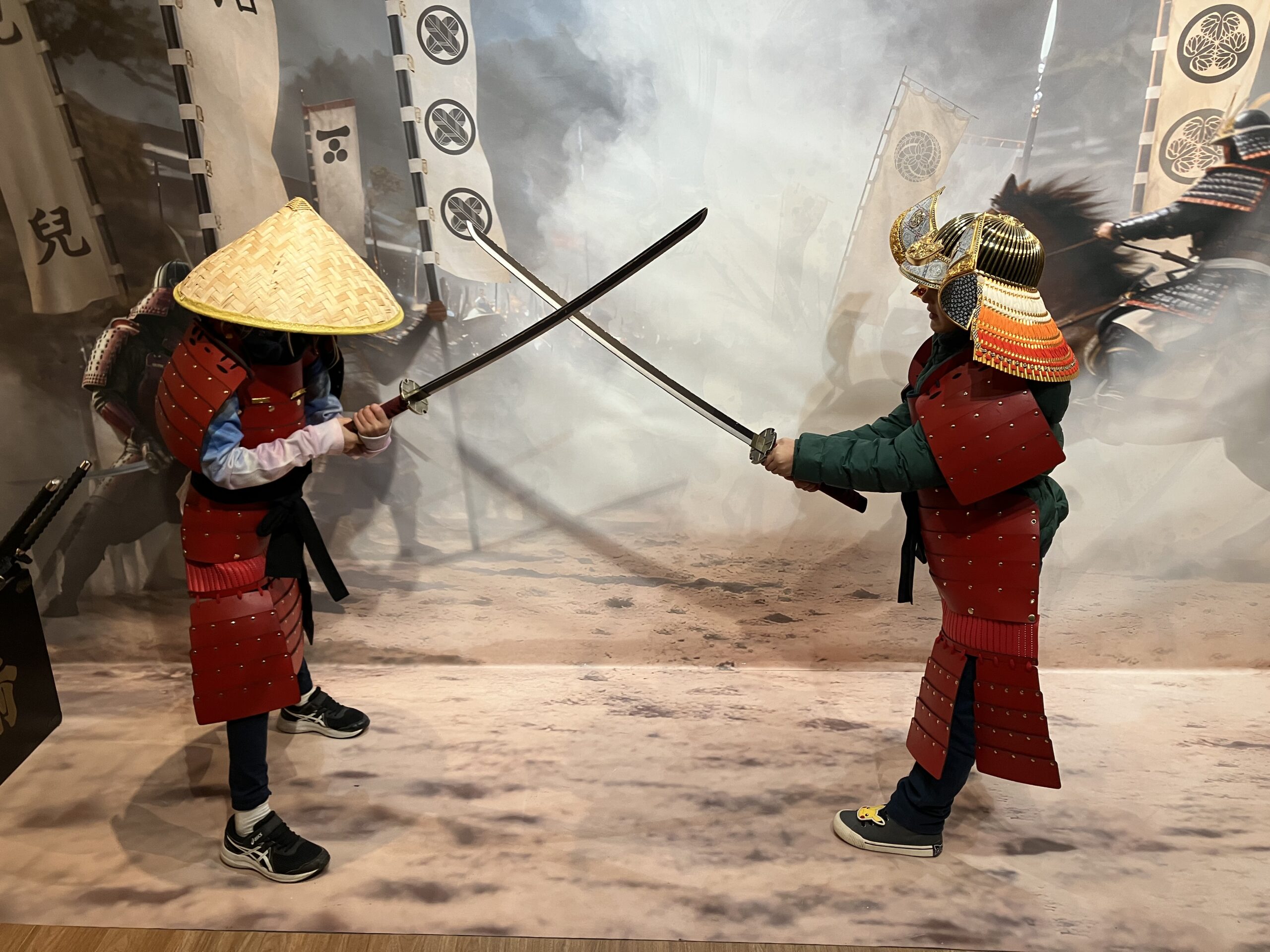
Top of our 7-year-old’s list from the moment we arrived in Japan – and it absolutely delivered. The 45-minute tour was so good: funny, interactive, informative and full of actual swords. We even threw shuriken (throwing stars) and the kids got to try on Samurai armour which they loved. This tour was suitable for both adults and kids and thoroughly enjoyed by all of us. 11,000 Yen/ USD$65 entrance fee for a family of four.
Verdict: Genuinely one of the best things we did in Tokyo. You have to book in advance as they won’t take walk-ins.
Book tickets for the Tokyo Samurai and Ninja Museum here.

2. Senso-ji Temple, Asakusa
Conveniently located just a 5-minute walk from the Samuari and Ninja Museum, Tokyo’s oldest and most famous temple – the enormous Kaminarimon gate and the approach through Nakamise shopping street is one of Tokyo’s iconic images. Genuinely atmospheric even with the crowds, which is pretty intense. Keen an eye on your kids!
The shopping street leading to the temple is excellent for kids – traditional snacks, toys, souvenirs – including plenty of swords – cheaper than the Samurai museum.
3. Shibuya Crossing / Shibuya district
The world’s busiest pedestrian crossing – up to 3,000 people crossing simultaneously when the lights change. This whole area is crazy busy, and gave us a true feeling of really being in Tokyo with advertising and neon lights all around. The crossing itself is hard to visualise from ground level – you need to get up high. The nearby Starbucks is the obvious and most popular choice, but they section off the viewpoint, and you can only enter if you’ve bought something and you don’t mind queuing. We settled for the ground level experience.
The Shibuya area is full of shopping – you’ll find a Pokemon centre and a Sega Store along with every other famous cartoon / anime store here.

4. Meiji Jingu Shrine
Just around the corner from Takeshita Street so can be combined together, this is one of Tokyo’s most important Shinto shrines, set in 70 hectares of forested parkland in the middle of Harajuku. A calm, beautiful contrast to the surrounding city. the shrine itself didn’t exactly set the world on fire for the kids, the forested walk to the shrine was a welcome space for the kids to run and jump over everything, away from the busy streets.
5. Pokemon Centres / Stores
If you have a Pokemon fan in the family, as we do, this is non-negotiable. There are several Pokemon Centres and Stores in Tokyo. The Mega Centre in Shibuya is the biggest, but when we went, there was a 3-hour wait. But we did manage to get straight into the one at Tokyo Station.


6. Tokyo SkyTree
At 634 metres, the world’s tallest tower. A trip to the observation deck here really puts the scale of this city into perspective. We went in the evening and the views were outstanding, with lights as far as the eye could see.
There are two observation decks and you can buy a ticket for the lower deck (350 metres) or one for both the lower and higher deck (450 metres). We chose the latter and paid online 10,700 Yen for a family of four. You need to book in advance as it seems to completely sell out each day, in our experience.
A word of warning
But what we hadn’t allowed for was the queues.
We were already tired from a long day elsewhere in the city and the only booking we could get was 7.30pm, getting close to the kids bedtime.
We were shocked to see such a horrendous queue, and it took us 45 minutes just to get into the lift to the first observation deck. The kids were in a complete meltdown by the time we get to the first deck. So, our time was limited and we didn’t even attend the massive queue for the higher deck. To our dismay, we then had to queue another 45 minutes to get back down. If they’d offered a bungee jump exit, I’d have paid for all four of us.
Tip: We don’t know if the queues were normal, but it might be better to early morning on a weekday with kids. Book in advance. If going in evening, just bear in mind our experience and allow extra time.
Book your SkyTree tickets in advance here.

7. Harajuku and Takeshita Street
Tokyo’s famous youth fashion district – colourful, busy, and wonderful for kids who enjoy people watching and trying unusual foods. Foods like the rainbow cheese toastie and massive candy floss. Our kids loved fuelling their sweet teeth.
8. Tokyo Station / Character Street
Centrally located and most metro lines easily arrive into Tokyo Station, there’s heaps to do in this area – mostly shopping.
Character Street is an indoor shopping street full of all the classic cartoon / anime stores. It’s absolutely heaving but the kids loved it and loved burning a hole in our pockets too!
There’s also a decent Lego store here if you’re kids love Lego.


The Japan Toilet & Bin Situation - An Important Section
Japan has taken the humble toilet and turned it into a technological masterpiece. This deserves its own section.
- More buttons than a spaceship – you need a degree to operate one
- Three levels of bidet – choose your own adventure
- Heated seats – a genius invention that makes you want to stay considerably longer than necessary – take a book
- Noise-masking button – plays running water sounds. Volume adjustable, depending on requirements
- Umbrella hooks at urinals – I had never once thought ‘if only I had somewhere to hang my umbrella’. Japan thought of it anyway
- Baby seats inside the cubicle – equal parts genius and disturbing
And yet, despite all this toilet wizardry, there are no bins anywhere in Japan. None. Not even in 7-Eleven. And still the streets are spotless. We spent the entire trip carrying 14 snack wrappers at all times because 7-Eleven packaging is 90% plastic and 10% food.

Tips for Tokyo with Kids
- Get IC cards (Suica or Pasmo) on arrival – essential for the metro
- Don’t over-plan – Tokyo is exhausting. We only managed one trip out a day and didn’t combine too many things. There were heaps of things we didn’t do but were just too exhausted.
- Book popular attractions well in advance – Samurai Museum and SkyTree especially
- Convenience stores (7-Eleven, FamilyMart, Lawson) are genuinely excellent for meals and snacks – quick bites on the go!
- Everyone follows pedestrian crossing rules – stopping at red lights, even when there are no cars. Do as the locals do.
- Nobody eats or drinks while walking – find a bench or stand still. We found this very challenging with kids!
- If you want to eat in one of the themed cafes – book ahead – literally months in advance, online
💡 Top tip: The real joy of Tokyo is simply being in it and experiencing the culture and way of life. Don’t try to see everything.
🐘 Wondering what a 9-year-old actually thinks about Japan? Read her review in our Kids Corner – click here
Costs and Budget for Tokyo with Kids
- Accommodation: 12,000 Yen per night for a 2-bed apartment (USD$75) in Kinshicho. This was considerably cheaper than places more central
- Metro: approximately 200-500 Yen per journey per person
- Meal (family of 4): 4,000-6,000 Yen (USD$25-37) – on a budget
- Convenience store meal per person: 500-800 Yen (USD$3-5)
- Samurai Museum (family of 4): approximately 11,000 Yen (USD$65)
- SkyTree: 10,700 Yen for family of four (USD$65)
- Overall daily budget (family of 4): 40,000-50,000 Yen per day (USD$250-300)
Is Tokyo Worth It for Families?
Yes – without question. But go in knowing it’s hard work.
Tokyo is not a relaxing holiday. It’s enormous, expensive, and navigating it with kids requires energy, patience and a good sense of humour. The metro can be confusing at first. Cheaper food can be found but accommodation is pricey and attractions soon add up but it can be done on a reasonable budget.
The food is awesome. The culture was so different, it was a joy to experience for both adults and kids. The highlights for the kids – throwing shuriken at the Samurai Museum, The Pokemon Centre, Anime / Cartoon stores, eating rainbow toasties and going up the Sky Tree – just not the queuing.
Five days felt like the right amount for a first visit with kids. We could possinly have had another couple of days to fit more in but we only had two weeks in Japan and were heading to Osaka and Kyoto to experience more. Five days was enough to get a real feel for the city without burning out completely and then leaving some bits to have an excuse to come back one day for more.
Our Japan Guides

Ready to Book?
🏨 Find family accommodation in Tokyo: here, or book where we stayed here.
🏖️ Book entrance tickets and tours in Tokyo here.
🥷Book your Samuari and Ninja museum tickets here.
🗼Book your SkyTree tickets here.
🚌 Getting there: books flights here.
🚄Book train tickets within Japan here.
📱Get your Japanese ESIM here
🛡️Buy your Travel Insurance here
This post contains affiliate links. If you book through these links we may earn a small commission at no extra cost to you — which helps keep Roaming Wild running. Thank you!
Frequently Asked Questions
Q: Is Tokyo good for families with young children?
A: Yes – with preparation. The metro was the biggest challenge for us, with young kids; it’s complex, often crowded, and requires patience. Outside of transport, Tokyo is extremely family-friendly – safe, clean, incredibly organised, with excellent food options and some brilliant child-focused attractions. Kids aged 7+ will get the most from it.
Q: How many days do you need in Tokyo with kids?
A: Five to seven days is probably ideal. Five days gives you enough time to see the highlights without burning out; seven days allows a more relaxed pace and seeing a bit more. We did five days and it was just about the right call.
Q: Is Tokyo expensive for families?
A: Yes – Tokyo is one of the more expensive cities in Asia. Attractions are the largest expense. Accommodation can be ridiculously expensive, but we managed to find a reasonably priced awesome 2-bed apartment. Transport isn’t too pricey and if on a budget, it is possible to eat without crazy prices but you’re limited to sniffing out cheap Ramen, Sushi, Gyoza or surviving from the awesome convenience store foods.
Q: Do you need to speak Japanese in Tokyo?
A: No – it can be very challenging without it. English signage is widespread at major attractions and transport hubs. But we were surprised at how little English is spoken by every day folk and interactions outside of tourist places. But the Japanese are very friendly, very patient and incredibly willing to try to help despite the language barrier. Our Japanese vocabulary consisted of Konnichiwa, Arigato and Toyota. We managed fine.
Q: What is the best area to stay in Tokyo with kids?
A: Shinjuku or Shibuya for central access and excellent transport links. But you’ll pay a lot more. Asakusa for a more traditional atmosphere and slightly lower prices. We stayed in a quieter suburb (Kinshicho) which gave us a different perspective on the city – peaceful but required slightly longer metro journeys to get anywhere.
A: When is cherry blossom season in Tokyo?
A: Late March to early April, varying by year. Ueno Park and Shinjuku Gyoen are the most famous blossom spots. Book accommodation months in advance if you plan to visit during this period – it is peak tourist season. We were just on the cusp of that season – blossoms were almost out but not quite but it also meant we got slightly cheaper accommodation.
You Might Also Like
Osaka with Kids: The Honest Family Guide to Japan’s Food Capital

Kyoto with Kids: The Honest Family Guide to Japan’s Ancient Capital

Japan with Kids: The Complete Honest Family Guide

Read our Tokyo blog: Tokyo with kids blog: Culture shock, crowds & temperature shock

Seoul with Kids: The Honest Family Guide to South Korea’s Mega-City