
At a Glance - what to pack for a worldschooling trip
- Trip type: Long-term family backpacking / worldschooling
- Kids ages: 9 and 7
- Duration: approx. one year
- Climates covered: Tropical, temperate, chilly
- Packing philosophy: Less is more: you can buy almost anything on the road
- Rule of thumb: If you haven’t used it in two weeks, ditch it
Key Essentials to buy
This post contains affiliate links – full disclosure at the end
At the time of writing, we are seven months into backpacking around the world as a family of four: two adults, two kids aged nine and seven, with approximately another five or six months to go until we return to New Zealand.
We have been through hot climates in Bali, Thailand and Malaysia to chilly early Spring in Japan and Korea onto the UK in late Spring/early Summer, where you just never know what on Earth, you’re going to get! We head via likely via a hit and sticky Asia again.
We have made packing mistakes, bringing things we hardly used. We have ended up ditching things we hardly used. Yet, other items, we have easily picked up on the road. So, we thought we would share our experience with anyone else researching what to pack for a similar trip.
Packing for a long-term family backpacking, worldschooling trip is completely different to packing for a two-week holiday. You are not packing for a fixed destination or a fixed climate. You are packing for a long time on the road, across multiple countries, through wildly different temperatures, with two children who will grow, lose things, break things, and occasionally refuse to wear things, just because, that’s kids.
Having travelled the world over as solo travellers and as a couple, we definitely now have the experience too of how different packing is as family to travelling alone or as a couple.
This is not a list of luxuries. This is what we used, day in day out, and what we genuinely could not have done without.
In This Article:
- Backpack or Suitcase? — it’s a tough choice
- Clothing: Packing for Every Climate Without Overpacking
- A Worldschooling Education: Homeschooling on the roadm incl Tech and Digital Nomad Gear
- Health and Medical Kit
- Documents and Admin
- Entertainment for Kids on the Road
- Gear We Could Not Have Done Without
- What We Ditched – the larger mistakes
- What to Buy on the Road
- Ready to Start packing? Our Recommended Gear
- Frequently Asked Questions
- Final Thoughts

1. What to Pack for a Worldschooling Trip: Backpack or Suitcase?
Your luggage is probably the most important decision you will make. Get it wrong and you could regret it pretty quickly.
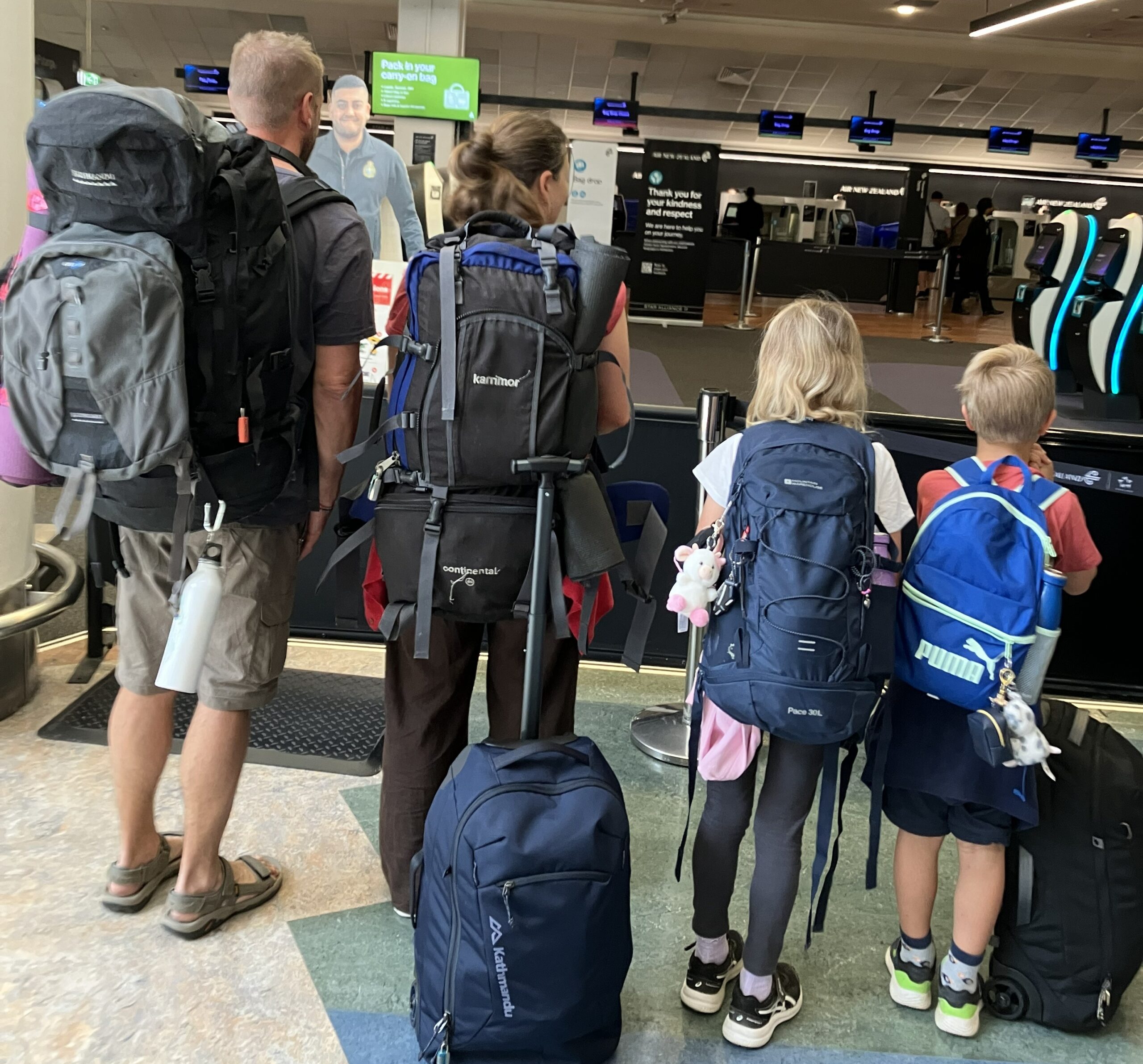
Having solely relied on backpacks for twenty-five years of various round-the-world trips, a backpack for the adults was an easy decision for us. For the kids, we landed on a 32- litre hybrid suitcase / backpack – which as it stands today, feels like the best decision.
Adult Backpacks: Karrimor 65L & Kathmandu Interloper 80L
On my first solo backpacking trip in 2000, I bought a 65-litre Karrimor backpack for £110. Arguably the best £110 I’ve ever spent, as that backpack is still going after three round-world-trips and dozens of other mini-backpacking adventures. With just one zip half stuck on the inside of the day pack, and a small hole from a rat who got into our loft and had a nibble at it, it’s incredible it’s still going strong. So, that was any easy choice.
For my wife, we bought a second-hand, hardly-used, Kathmandu Interloper 80-litre backpack that had good reviews online and to be fair has done a decent job, albeit not quite as comfortable to wear as the Karrimor.
Is 65L and 80L enough? We try to spread the weight between us and so far, the heaviest our bags have been at airport check-in is round 18KG each. Whilst they’ve both felt bulgingly full at times, we know we could squeeze that extra 2KG in each if needed and on a 20KG limit.
Kids Backpacks – Kathmandu 32L hybrid
We done a lot of research into what would work best. We felt backpacks would just be too heavy but then given our backpacking history, we felt that a trolley suitcase may not fit our requirements. So, we settled on the Kathmandu 32-litre hybrid.
At airport check-in, their bags have been between 7KG to 9KG.
Given the experience we have of travelling, we know that quality is important for the luggage. The last thing you need is a zip to snap, a wheel to fall off or the material to tear. These hybrids are beasts. In the end we have hardly used the backpack option, only a handful of time, but useful to know it is there. The pull-along trolley suitcase option has been perfect for the kids to manage their own luggage when on the go.
Despite all the above, we are currently in the UK and are considering ditching the backpacks for suitcases. For two reasons:
- We found when travelling alone or solo, that we would often walk sometimes 2-3KM from bus to accommodation, or there would always be a reason to save a few bucks by walking. With kids, sometimes you just got to get to the accommodation, no messing. And so, we have found that a backpack isn’t as necessary.
- A little more space. We have bought more as we go, and certainly since we’ve been in the UK the past couple of months, the kids have bought a few more toys that they would like to take back. Yes, we could send a package back home, but they will still want to play with those toys for the rest of the trip.
This decision though may mean that we exceed the 20KG limit with some airlines. Although, we have also found since travelling with kids, that the low-cost airlines just don’t work for us anymore. The 3.30am start to get the cheap 6am flight, or the flight with no food, or no entertainment just doesn’t work for us as easily as it did when travelling solo. So, paying that bit extra with a bigger airline to get the extra comforts often also means a bigger baggage allowance.
We will update this page once we start flying again.
Day Packs: keeping it simple
For our day packs / airline hand luggage, we haven’t done anything special. We have found that the day packs listed below only get used when we fly / travel around and so aren’t really carried much.
For our actual day pack that we use every day for things like,water bottles, sunscreen, hats, snacks – we have managed with the day pack that detaches off of the Karrimor 80L backpack.
One tip if you plan to do the same and just use one day pack – we have found it so useful having one with lash tabs that things can be attached to, deep water bottle pockets and bungee lacing. We often tied wet clothes, caps, water bottles (with carabiner) or other items to the outside when we picked up other items on the journey for the inside.
We also always took a foldaway rucksack in the bottom of the day pack so that if we did buy anything whilst out, we had another bag that hadn’t taken up hardly any room. To be honest, this was a brilliant decision as we would often grab some unplanned food shopping or buy something else.
Dad: the largest day pack with multiple compartments to store all my digital nomad gear that can’t go in the check-in baggage, pushing the boundaries of the 7KG limit.
Mum: a standard typical day to day rucksack
9-year-old: we got her an adult 30L daypack which wasn’t a great choice as it’s just too big, and although we’ve managed, we will get her a kids backpack before leaving the UK.
7-year-old: tiny 12L backpack that just fits his essential toys, some food, and tablet for the flight


2. Clothing: Packing for Every Climate Without Overpacking
Subject to which countries you’re going to and what time of year, clothing can be the hardest decision making. Especially with kids.
Our Approach to Different Climates
We generally travel with the sun by planning our route to stay warm and dry. But this may not be the case for everyone and even our plans changed meaning we hit the colder northern hemisphere earlier than our original loose plan.
But because we only had a loose plan, we didn’t see the point in packing for something that may not happen. So, we packed light, for the sun which we knew we would experience for the first few months and then decided we would deal with the rest as required.
In the end, we had four months in a hot Southeast Asia, three weeks in a chilly Japanese/Korean Spring and a temperamental Spring in the UK. As it write this, it’s 14 degrees in the UK Summer compared to 16 degrees back home in Auckland. We sometimes wonder what we’ve done!
We packed Summer clothes for Southeast Asia with just one pair of long pants / long sleeve top each and then bought what we needed when we were heading to colder climes.
In Malaysia we found some great second-hand shops and picked up warm layers for the kids at a fraction of new prices. We bought a couple of brand-new items where quality really mattered – like jackets for the kids. Some of the Summer gear that we had all been wearing week in, week out for four months we just ditched. Lighter bag, no regrets.
The rule we followed: Never carry clothes for a climate you are more than three weeks away from. You can buy what you need when you get there or just before.
Clothing Per Person: Adults
- 3-4 lightweight t-shirts (both)
- 2 x vests / singlets (both)
- 1 short sleeve shirt (dad)
- 2 dresses (mum)
- 1 lightweight long pants
- 2 pair shorts (both)
- 1 pair of home-only lazy shorts
- 1 lightweight waterproof jacket
- 1 lightweight fleece / hoodie
- 8 pairs of underwear
- 2 pairs of socks
- 1 Sun hat
- 1 pair swim shorts / swimsuit
- 1 pair of trainers / hiking shoes
- 1 pair of sandals
- 1 pair flip flops
Clothing Per Person: Kids
- 7 T-shirts – kids go through them faster than you think
- 3-4 pairs of shorts
- 1 pair of lightweight long pants
- 1 lightweight waterproof jacket
- 1 long sleeve fleece / hoodie
- 8 pairs of underwear
- 2 pairs of socks
- 1 Swimwear
- 1 Sun hat / cap
- 1 pair of crocs (7-year-old) / 1 pair flip flops (9-year-old)
- 1 pair of trainers each
- 1 pair of sandals each
3. A Worldschooling Education: Homeschooling on the road
Worldschooling is a huge education. Our kids have subconsciously absorbed so much knowledge whilst on the road, it’s hard to comprehend the sheer volume of experiences that they have had outside of their ‘normal’ comfort zone – more than the average adult has in a lifetime.
We have mixed worldschooling – learning from experiences whilst on the road with a more traditional homeschooling approach, of core subject learning.
Whilst we have an unschooling philosophy, we also aim to focus on core subjects regularly.
Every day is different depending on where we are, what we have planned, how everyone is feeling, how long we are staying in the location. It’s wonderfully flexible.
We found that having a base for several weeks or months helped us get into a good rhythm whereas when we moved around a lot, it was harder.
The biggest issue we have found is the ability to print material. At home we had a printer constantly in use but on the road, this isn’t possible unless you want to spend each day at the local printers (if you can find one) and spend a small fortune.
So, we have found that we have switched to more digital use but found it can still work very well without it feeling it’s constant screen time.
We continued to use the same tools that we had back at home, but it just meant that rather than printing, we read off the screen and the kids re-wrote some exercises out in their notebooks. We use The Good and Beautiful curriculum. Whilst their curriculum has a religious context, and we are not religious, it isn’t overpowering and the content and structure is incredible. We use them for their Language Arts, Maths and their epic Science models. Their history modules are great too, although we’ve not used them yet.
We love the work of Brett Pike at Classical Learner and follow his work online.
We have recently started to use AI to help create a standard daily template of content for us, which, love or hate AI, has really helped us save time, and get into a very regular routine flow with some incredible critical thinking debates.
So, we left home literally with just:
- A notebook each
- Pencil case with pens, pencils, colouring pencils, eraser, pencil sharpener, ruler
- 1 x Maths and English textbook for our youngest to compliment the online PDFs
- Our kids are incredibly creative and love to just make stuff, so we made sure we had a few items like stick glue, craft glue, lolly sticks, pipe cleaners etc with us but these were also easily bought on the road
- We also bought some small cheap magnets and Blu-tack on the road to put up their artwork on the fridge and walls to make our accommodation feel homely.
- A memory stick for taking documents to be printed at the local printers, which we still did on occasions.
Devices
- We travel with one laptop for each adult for personal use, work, and delivering homeschooling. Our 9-year-old has a laptop that she uses primarily for learning but also for long journeys for movies. Our 7-year-old has just a tablet, used for movies on long journeys only.
- The kids have their own headphones. Essential for those long journeys.
- We have 2 x Power banks: one small one for mainly charging a phone on the go and a larger powerful one that charges the laptop, which is crucial if needing to be connected on the go with no plug available
- Universal travel adaptors x 3: we seem to have a lot of devices. What we like about these chargers is that they have direct USB charging as well as plug charging.
- E-Readers – Incredible at saving space compared to traditional books, although we miss the feel of a ‘real book’. After much research we opted for Kobo (Kobo Clara & Kobo Libra) over other brands, mainly because of their link to Overdrive, the worldwide library app, but we still it limited in being able to borrow books for free. We did also manage to get some free PDFs and upload. Our 9-year-old book-worm has made the most of it.
- If you do take books, one of them mini torches is useful that clicks to the book, as sometimes when you’re all in one room, or the kids are sharing, one may want to stay up reading after lights out. We bought one on the road, as we picked up some books here and there.
- Spotify – I had (very naive) visions of us traveling – laying in hammocks, reading books, listening to music. So, I changed our single Spotify account to a family one so all 4 of us could listen at once. I changed it back to a single account after a few months, as we never found a point when more than one wanted it at a time!
Connectivity
- Whilst most places we’ve stayed have had free WIFI, sometimes it’s been a bit patchy and we’ve relied on cellular hot-spotting. To get connected abroad, we have used an e-SIM for the first time in each country. We have used Airalo e-SIM, which has work seamlessly brilliantly in each country we’ve been. they cover dozens of destinations.
4. Health and Medical Kit & Wellbeing
With kids on the road, a decent medical kit is non-negotiable. You will not always be near a pharmacy and even when you are, finding what you need in a language you don’t speak is a challenge.
What We Carry
- Paracetamol and ibuprofen: adult and child doses
- Antihistamines: or allergic reactions, insect bites and hay fever
- Re-hydration sachets: essential for hot climates and stomach bugs
- Antiseptic cream and plasters – 7 months in and I think we are on our 6th box of plasters. The kids’ knees have constant scabs. We see it as a positive sign of them being active and free.
- Diarrhea medication
- Insect repellent: kids-safe formula
- High factor sunscreen: we use a natural non-chemical brand
- Any prescription medications: we carry an Epi-pen and made sure we got a new one just before we left so the use-by date stretched as long as it could
- Small first aid kit with bandages, sterile wipes, tweezers, medical scissors, safety pins, a mini first aid guide
- To keep ourselves fit we have travelled with a exercise resistance band & we took one yoga mat to share between us
5. Documents and Admin - The Stuff You Cannot Afford to Lose
This is the boring section but get it wrong and everything stops. Here is our system:
Physical Documents
- Passports – check expiry dates well in advance, many countries require 6 months validity beyond your stay
- Printed copies of travel insurance policy
- Any required visas: check requirements for every country in your itinerary
- International driving permit if you plan to hire cars: we found this essential in Southeast Asia. As it only lasts a year, best to get just before leaving your home country.
Digital Backup
- Scan everything and store in a Cloud Drive (We use Proton Drive – here)
- Email copies to yourself and a trusted person at home
- Screenshot your travel insurance emergency number and save offline
Travel Insurance: Do not travel without it. With kids especially, the risk of medical emergencies is too high.
Buy travel insurance here
6. Entertainment for Kids on the Road
Long travel days, waiting rooms, overnight buses and rainy afternoons in guesthouses will test any child’s patience. And yours. We left with too many games and ditched some. Here is what we kept and what the kids sue to amuse themselves:
- Lego – we weren’t too sure on the decision to pack a fair amount of Lego but it was worth it. Not just for the kids, adults too. Lego is incredible and our kids love it, and so it has saved us many times when boredom kicks in. We filled a 4L bag stuff with random pieces.
- A pack of cards: our 7-year-old wasn’t interested in cards when we left but is now the first to be the dealer. So playing cards is our go-to for those tough times.
- Pass the Pigs: A simple game that once the storage box is removed, takes up zero space and is a great way to kill 30-60mins. And improve the kids’ maths skills.
- Colouring books and pencils: We took one each for the kids and easily bought many more on the road
- Downloaded movies and shows on tablets: essential for long journeys
- The kids left home with one soft toy and one plastic toy each, however we have allowed them to buy more so far on this trip, whether that’s been a good decision or not, as their bags are close to full, but it’s meant they’ve enjoyed new toys as they’ve gone rather than getting bored of toys from home quickly.


7. Gear We Could Not Have Done Without
- Reusable water bottles: we always use water bottles at home and our now battered, colourless steel bottles are still going strong. I found if 1 or 2 have a carabiner on them, they can be attached to the outside of the day pack should it get full of other items
- Fold up portable rucksack: this has been one of the best things we packed. When going out for the day, we generally fit everything we need into the one day pack: water bottles, caps, sunscreen, 1st aid kit – but we always leave inside our foldaway rucksack in case we buy something else or go food shopping. This has been the case many times and it’s so easy to whip it out and fill it up rather than using plastic bags from the store.
- Sarongs – we’ve always travelled with sarongs because they are so versatile, extremely lightweight, non-bulky and fast-drying. We use them sit on, on the beach, as a beach towel, a park blanket, the kids use them to build bases, we had to use one once when a blind fell down. We never leave home without them.
- A multi-function knife: this has been used a lot. From the bottle opener to the saw, from the screwdriver to the pliers – all the tools have got some use.
- Travel washing line: this may seem like a minor item it has had so much use. Many of the places we stayed little or no options to dry washing and so this bungy style line was life saver given the amount of washing needed when packing light.


8. What We Ditched – the larger mistakes
- Micro-fibre quick dry towel: we were indecisive whether we needed these. Staying in hostels when traveling pre kids, we travelled with them all the time as towels are generally not provided. We went and bought one each for all of us for this trip. But we ended up ditching them. Whilst they pack up small, the four of them were not being used as everywhere we stayed had towels, and in worst case if needed, we had our sarongs.
- A bumbag – I had all good intentions that this would be essential to carry all important things with me. I shopped around for months to find the right size and style. And didn’t use it once. The day pack was enough to cover all of us. It got ditched at the local charity shop still looking brand new.
9. What to Buy on the Road Instead of Packing from Home
One of the biggest lessons from long-term travel is that you do not need to pack everything from home for all climates. We followed the sun for 4 months in SE Asia before heading to the colder northern hemisphere in Japan, Korea and the UK. Before we left SE Asia, we ditched some worn out summer clothes and bought second-hand or cheap warm clothes.
- Warm layers for cold climates – buy second-hand in SE Asia before heading north, leave behind when no longer needed
- Cheap beach gear: I left home with just sandals. Whilst I prefer flip flops, I felt sandals would be better as we planned to be quite active, doing short hikes and likely climbing over rocks etc – not suited for flip flops. I found them too clunky and bought some cheap flip-flops for the beach and general lazing around, but the sandals were still useful for longer walk. So, I now travel with both. Flip flops will tuck into any tight space when packing.
- Kids clothing: our kids get through clothes so quickly – either outgrowing them, staining them, or getting multiple holes. Kids clothes are cheap on the markets in the countries we visited, so we bought many on the go.
- Plasters – honestly, I cannot believe how many plasters we have got through!
- Toiletries in bulk: we left home with enough to get us through several weeks but didn’t over pack, and then just topped up on the road. Many guesthouses included them anyway so we haven’t had to buy too much.

10. Ready to Start Packing?
Our recommended gear:
- Kids headphones:Buy from Amazon here
- Universal Travel Adapters: Buy from Amazon here
- Kobo Clara: Buy from Amazon here
- Kobo Libra: Buy from Amazon here
- Pass the Pigs game: Buy from Amazon here
- Fold-up rucksack: Buy from Amazon here
- Multi-function knife: Buy at Amazon here
- Travel washing line: Buy at Amazon here
- Exercise resistance band: Buy at Amazon here
- Get your ESIM here
- Get your Travel Insurance here
- Proton Drive for file/document cloud storage here
This post contains affiliate links. If you book through these links we may earn a small commission at no extra cost to you — which helps keep Roaming Wild running. Thank you!
11. Frequently Asked Questions
Q: How do you manage laundry on a long trip?
A: Most guesthouses and hotels either have laundry facilities or a laundry service nearby, often at very low cost. In SE Asia we done a weekly wash, sometimes more frequently. Laundry powder is available everywhere.
Q: How heavy are your backpacks?
A: When we checked in to leave at Auckland, Adults were 18KG each and the Kids 9KG each. Every flight since has been something similar despite us buying more stuff on the road, because we’ve also ditched stuff.
Q: How do kids cope with carrying their own bag?
A: We found the hybrid to be the perfect choice and the majority of the time, it’s been on wheels rather than the backpack as the backpack isn’t that comfy and would still be too heavy for them. Their day packs are small although we made the mistake of giving our 9-year-old an adult pack which was the wrong choice.
Q: What do you do about schoolbooks and supplies when travelling with kids?
A: We use online PDFs for most of our learning and some online content. The kids just have their notebooks and plenty of art supplies for crafts.
Q: Is it possible to travel light with kids for a whole year?
A: Absolutely. In fact, we found that travelling lighter made everything easier. When we stopped in a base for some time, we did accumulate stuff, and the kids made some cool creations – but whilst we had to make some tough calls, we were pretty ruthless in ditching stuff and moving on only with essentials.
12. Final Thoughts
The perfect packing list does not exist, because every family is different, every trip is different and each journey throws up surprises. What we can tell you is that after seven months on the road, with six countries under our belts, we have refined this list down to what genuinely matters.
Pack less than you think you need. Trust that you can buy what you are missing. And focus on the experience rather than the stuff.
If you found this useful or if you think we have missed something essential, let us know in the comments. We are always learning too.
You Might Also Like
Read Our Travel Blogs from round the world

Browse Our Family Travel Guides from around the world