
Athens: Plaka Charm & Finding the Acropolis
My earliest memories of learning about the Ancient Egyptians was aged about 7, where at school, we made primitive house bricks from mud and straw to demonstrate how the slaves of Egypt built their own houses while the elite Pharaohs ruled over their land. From that day, I have always been fascinated by the Egyptians – and when the opportunity came in 2002 to finally visit with my partner, I jumped at the chance.
We landed in Athens, our stopover to Egypt, in the early evening and immediately walked the wrong way trying to find our hostel – a classic start.
Eventually we stumbled into The Student & Travellers Inn in Plaka, tucked down a quiet side street. Double room: small and pokey. Bed: damp and itchy. Welcome to backpacking – Greek style.
Plaka itself was a stunning part of Athens – narrow lanes, old houses, lively tavernas.
We tried to glimpse the Acropolis perched high up on the hill, located somewhere behind our hostel, but we mostly saw shadows and scaffolding.

Acropolis, Ruins & A Cinematic Nap
In the morning we set about to tackle the Acropolis – Athens’ ancient citadel perched atop a rocky hill, made up of several building dating back around 2,500 years.
After a short steep climb, we were at the summit of Acropolis Hill, 90 metres up above the city.
We wandered around the Parthenon, and other ancient ruins – the Caryatids and the Theatre of Dionysos.
Not particularly into Greek history (at the time), whilst on the one hand, it was just a bunch of olds ruins, on the other – ruins of a civilisation that gave birth to modern society riddled with so many myths and legends. Tired, I couldn’t tell if I was impressed or bored.
Back down at city level, we walked for miles, exploring different parts of Athens. We walked so far that our feet could not take it anymore.
As we had already checked out of our room ready for our flight later that day, there was only one thing for it. We paid 6 Euros to watch the move Blade 2 – with the sole reason not to watch such trash, but to curl up and have a nap. Luckily, it was empty and we managed to stretch out and grab a priceless couple of hours sleep while the movie rattled on in the background.
We grabbed our bags from the hostel and headed back to the airport for our late‑night flight to Cairo.

Cairo: Pyramids, Heat & a Dodgy Breakfast
After arriving late at night, we woke in Cairo to a ‘free’ breakfast of rock‑hard rolls that could hammer a nail into a wall, tiny blobs of jam – not large enough to feed an ant and boiled eggs that looked like they’d bene laid by a hen with serious internal problems. We still ate it.
We had booked a semi-flexible tour – where a guide and driver would take us around some sights and organise some of our transport but in between, we would have plenty of free time and choice to do what we wanted.
Our first guide, Fayed, picked us up and drove us to Saqqara, home of Zoser’s Step Pyramid – the first pyramid ever built.
The history was incredible; the heat was not. We were starting to melt and were soon wishing that Blade 2 was also showing in Cairo.
Our next stop major stop was Giza.
Seeing the Great Pyramid for the first time was a surreal experience – 2.3 million blocks, each weighing up to 15 tonnes – the sheer scale is mind boggling. How anyone believes these structures were made by humans; I struggle to comprehend.
We got to go inside and explore Chephron’s pyramid – not that there was much inside apart from even greater humidity – but the precision of the structure was obvious even from someone who struggles to put two pieces of Lego together. Someone had some serious engineering knowledge back then.
Outside, in the cooler heat, we took a camel ride which did no favours to my back problems – but an experience to say the least. And not a bad setting to experience it.
We visited the Sphinx, defaced by Romans but still magnificent.
We had Dinner at the Lonely Planet recommended – Felfella restaurant which did not disappoint – it was an incredible feed – before we boarded our overnight mammoth train to Aswan, in the south of the country, towards Sudan.
Travelling on a budget, we were in third class, which meant reclining seats and air‑con – surprisingly they were comfortable. Although I think the sleeping pills helped.

Aswan: Temples, Dams & A 4 Star Ghost Hotel
We arrived in Aswan mid‑morning and were met by a new guide who called himself Eddie Murphy. He took us to the Kalabasha Hotel, a 4‑star place with Nile views and absolutely no other guests. Eerie, but peaceful.
We visited the High Dam, then took a boat to Philae Temple, covered in beautiful hieroglyphics.
A felucca ride, a traditional triangular-sailed, was planned, but it turns out you need wind for a felucca to move and sadly we were out of luck, the day could not have been stiller. We ended up on a motorboat around Elephantine Island instead.
After dinner, we went for a walk about the local market. Everywhere we went everyone thought we were Australians. Just how many Aussies come to Egypt? Must be heaps, as not one person guessed we were Poms.

Abu Simbel: 3am Convoy & Ramses II Glory
The next day, we were up at 3am for a convoy through the remote desert, further south to the temples of Abu Simbel. Apparently its easier for all the tour groups to convey together in case of any issues. What issues, we were never told.
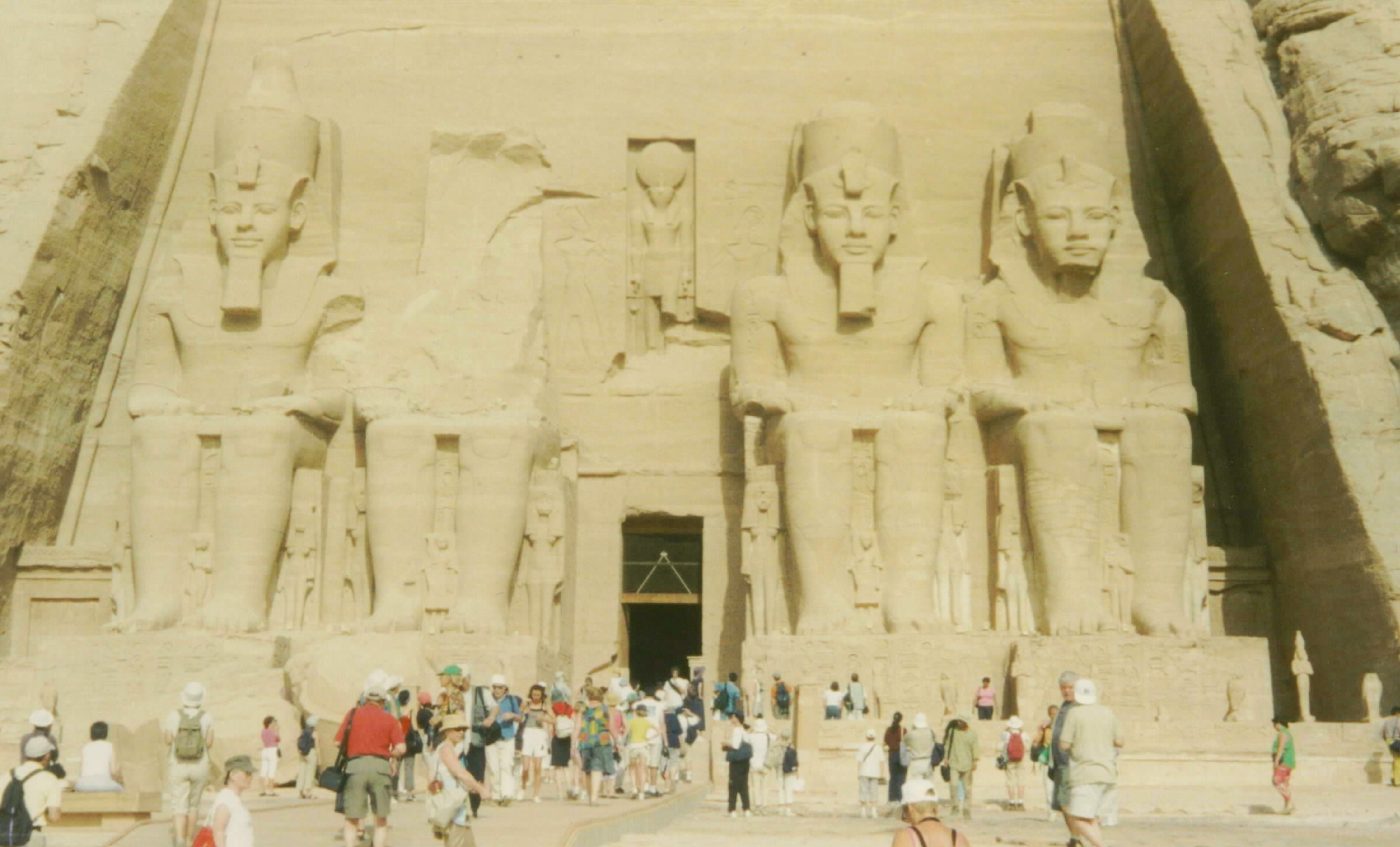
After a cramped ride and a picnic breakfast, we arrived at 7:30am – and the sight was jaw‑dropping.
The colossal statues of Ramses II emerging from the cliff face were worth every minute of lost sleep.
Inside, not only are the temples were breath-taking in their design, art work and precision but also their link to the sun. On the the back wall – are rock cut sculptures of four seated figures: Ra-Horakhty – the deified king Ramesses, and the gods Amun Ra and Ptah. On October 22 and February 22, the rays of the sun penetrate the sanctuary and illuminate the sculptures on the back wall, except for the statue of Ptah, a god connected with the realm of the dead, who always remained in the dark. Ancient Egyptians, whoever they were, didn’t mess around. They knew their stuff – the stars, the sun, and how to build stuff.
By 10am we were back in the van for the three‑hour return to Aswan.

The Nile Cruise: From Backpacker Budget to 5 Star Luxury
Back in Aswan, we were set to board our cruise boat for our 2-day trip up the Nile River. We were shocked when we reached our boat – Le Beau Soleil – a 5‑star floating palace. Air‑con, TV, luxury bathroom, balcony doors opening onto the Nile. Deck with pool, jacuzzi, hammocks, bar. We couldn’t believe our luck. This was a massive upgrade from our usual dives.
Lunch was included, so we ate like animals.
Then sunbathed on deck, practically alone – there was just a handful of other guests on a massive boat.
We had dinner with our guide which was fascinating as we learned about Egyptian traditions, military service, arranged marriages, hieroglyphics, gold mining, and Queen Hatshepsut’s fake beard.

Kom Ombo & Edfu
We woke early for a visit to Kom Ombo Temple, home to crocodile mummies and the ancient Egyptian calendar. Breakfast was provided back on the boat and was a six‑course feast. There may have only been a handful of people on board but at this rate just the few of us would be carrying the weight of 200.
Our next stop was Edfu – reached by horse and cart -although our horse looked like it needed a retirement plan. The Temple of Horus was the highlight – huge and impressive. The structures just never ceased to amaze.
Back on board, dinner that night was – Egyptian dress‑up night – it seemed despite there only be a handful of fellow passengers, they all made the effort – except we didn’t. A bunch of Aussies mocked us – we didn’t care – we ate three rounds of food to cope.
At night, the boat then had to skilfully pass through a series of locks, the Esna locks, before we passed out, bellies still full.

Luxor: Valley of Kings, Queens & 10,000 Camels for my partner
We woke up a little confused as Egypt had daylight savings time change overnight, and no one told us. So, we had to scoff our breakfast and quickly headed to the Valley of Kings.
We visited the tombs of Ramses III, Amenophis II and Ramses IV – all incredible with the most articulate hieroglyphs inside the tombs. .
We then went to the Valley of Queens and Queen Hatshepsut’s massive temple carved into the cliffs.
In one tomb, a mummified foetus lay inside – was there anything these guys didn’t mummy.
At an alabaster factory, I was offered 10,000 camels for my partner. I had no idea of the price of one camel so I couldn’t comprehend in my mind if this was a good offer or not. After considering the options of how I would transport 10,000 camel’s back to England, who would look after them and ultimately, what I would do with them, as tempting as it was, I declined. Plus, she was right there, hampering my ability to negotiate.
We checked into the Mercure Hotel, another 4‑star beauty, and spent the afternoon by the pool. Dinner at the Kings Head English Pub was a welcome break from Egyptian food, where a roast dinner saw to our needs.

Karnak, Luxor Temple & Final Cairo Days
The next morning, we explored Karnak Temple – one of the largest temple complexes currently known to modern man, to have ever been built, taking up an enormous 100 hectares. This mind-boggling complex is full of temples, chapels, a sacred lake and other structures built 4,000 years ago.
As if that wasn’t enough, we were soon starring in awe at Luxor Temple – another great engineering feat – relatively ‘new’, at just 3,500 years old. What I found astonishing about all these temples is how intact they are. I’ve visited many ruins around the world – and found them to be just that – ruins. Often a bunch of old rocks laying around and struggled to find that wow factor. Here in Egypt, it’s almost possible to imagine how they were thousands of years ago. Luxor was the most impressive of the lot.
Later on we bought souvenir cartouches (our names on a necklace in hieroglyphs) , tipped our guide, and spent the afternoon by the pool before catching our overnight train back to Cairo.
Back in Cairo, we visited the Egyptian Museum, including Tutankhamun’s treasures and the Royal Mummy Room. Tutankhamun’s mask being the highlight – weighing 10kg of mostly gold.
Then we went to Coptic Cairo, the Hanging Church, and Sultan Hassan Mosque. This city and country just did not stop failing to deliver with sights.
We spent our final evening wandering the city, bargaining in markets and eating at Felfella again.
Eventually we had to say goodbye to this impressive country.
It had been a superb holiday that I would never forget and fulfilled so many childhood dreams.
You Might Also Like
Visiting Israel – in the footsteps of Jesus

Read more of our blogs from around the world

Read out travel guides from various places around the world