
My first taste of a South Pacific Paradise
Leaving the isolated islands of Hawaii behind, it wasn’t long before the deep blue of the vast Pacific Ocean was all I could see out of the plane window: hour after hour, nothing but endless water. Then, after several hours of ocean monotony, the remote Cook Islands finally appeared beneath us.
On the way in, we flew over one of the most breathtaking sights I’ve ever seen: Aitutaki.
After hours of staring at the world’s biggest puddle, suddenly there was a tiny speck of land rising out of the ocean, glistening like a jewel. A rugged green interior wrapped in turquoise lagoons, dotted with tiny motu (smaller islands), all encircled by coral reefs. I told myself right then: I’m landing in Paradise.
Arrival in Rarotonga
As the wheels touched down on Rarotonga, the Cook Islands main island, I glanced out the window and saw a small shack beside the runway. “The terminal must be on the other side,” I thought. Nope. The shack was the terminal. The other side of the runway was a rainforest‑covered mountain.
Looking back down the runway, it was hard to believe a 747 had just landed on something that looked like it belonged in a model train set.
We were greeted with a traditional song, breezed through passport control, and I was soon on a shuttle heading to my hostel on Muri Beach, supposedly the best beach on the island.
A Tiny Nation in a Giant Ocean
The Cook Islands are split into a Northern and Southern group. The scale of the Pacific becomes obvious when you realise that even though they’re part of the same country, it’s still a four‑hour flight from Rarotonga in the south to Penrhyn in the north.
Rarotonga itself is tiny – home to just 10,000 people and one 35km road looping around the circular island. You can drive the whole thing in 45 minutes. What makes the Cook Islands so special is the lack of mass development: not a single building over two storeys, no big brands, no resorts towering over the beach. It feels like escapism in its purest form.

Island Life Begins
I spent my first few days making friends at the hostel and chilling on the palm‑fringed white beach overlooking the lagoon. Paradise, basically.
Then came the Cross Island Trek – a 12km hike straight through the rainforest to the opposite coast. It’s hard to get lost; whichever direction you choose, you’ll eventually hit the sea.
In the centre of the island stands The Needle, a jagged rock spiking up through the forest. A narrow ledge runs off it with a sheer drop hundreds of feet below. Not ideal for anyone with a fear of heights or common sense. But young and brave (or stupid) back then, I scrambled up using a chain hammered into the rock and perched on the ledge for the obligatory photo. One wrong move and I’d have been part of the scenery.
After four sweaty hours, I reached the other side of the island and headed for a waterfall described by Lonely Planet as a “refreshing natural plunge pool.” What I didn’t read was that this was only true in season.
October was not in season.
I got a bone‑dry puddle and a sad trickle of water.
The World’s Strangest Golf Course
Rarotonga even has an 18‑hole golf course. Sort of. There are only 9 tee‑offs and 9 greens, so you play everything twice. And there’s just one fairway. You basically tee off from 9 different spots onto the same patch of grass and chip onto 9 greens — one of which was about 5 feet wide.
It was the most bizarre course I’d ever played… except maybe the one in Zimbabwe where there were special rules for zebra poo obstructing your shot.
Aitutaki: The Jewel of the Pacific
With ten days in the Cook Islands, I decided to splash out and visit other islands. First up: the jewel I’d seen from the air – Aitutaki, home to a lagoon recently voted the third best on the planet (if you believe those sorts of lists).
The plane was a tiny 15‑seat prop job where I could see the pilots sharing a pork pie. I tried not to focus on that and instead glued my eyes to the window, watching lagoons, motu and beaches drift past below.
If Rarotonga had a shack for a terminal, Aitutaki had a shed – at the end of its sandy runway.
Minutes after landing, I was in the back of a ute heading to Tom’s Cottage, a budget accommodation full of cockroaches. Very budget.
I hired a moped off Tom for a few bucks a day and explored the island, home to just 2,000 people. On Sunday I visited the local church, where 30+ Polynesian women filled the modest building with deafening, beautiful harmonies. Worth every minute.
Aitutaki is also famous for its huge land crabs. They creep out of their burrows, sunbathe, and then scurry back underground the moment my scooter got within a few metres.
One Foot Island
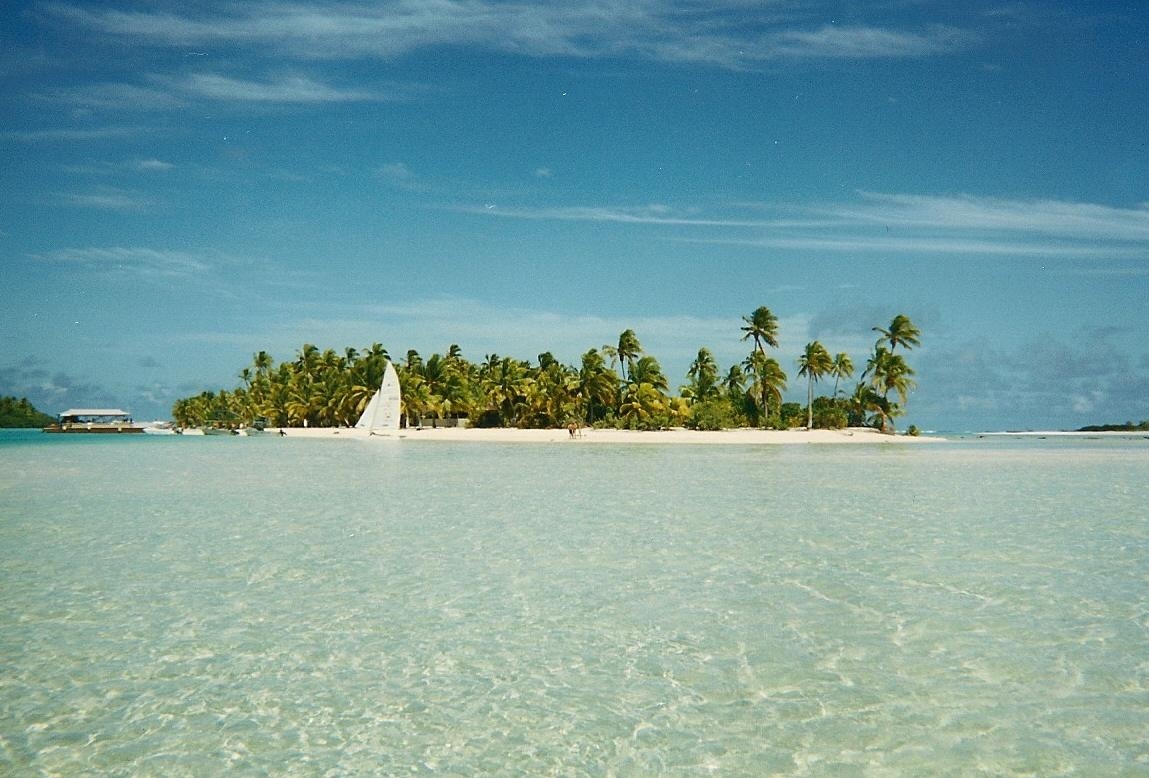
One Foot Island is probably the most photographed spot in the Cook Islands. Reached by local boat, it’s postcard perfection: white sand, swaying palms, turquoise water.
It gets its name from a legend – a father carrying his son across the beach to hide him from attackers, leaving only one footprint. The attackers left, the boy survived, and the island got its name.
Today, you can get your passport stamped there and buy a beer from a shack. Paradise with admin.

Atiu: The Wild One
If Aitutaki had a shed for a terminal, Atiu had a dog kennel.
Another 45‑minute prop flight and I was on an island of just 450 people. Geologically different, Atiu has caves, massive pigs, and jungle‑covered makatea – fossilised coral from when the island was underwater millions of years ago. It’s sharp enough to slice you open, and often hidden under foliage. A fun combination.
Both lodges were full, so I ended up staying with a local family – an English father, Atiuan mother, and two kids, who had previously lived in Sheffield. I still don’t understand how that decision happened.
“Darling, shall we stay in this grey, wet, miserable mining town forever, or move to your tiny tropical island thousands of miles from anywhere, surrounded by beaches, lagoons and pigs?” (Sorry Sheffield, you do have some great nightlife!)
Tough call.
They were incredibly welcoming and lent me their son’s bike to explore the island. After dodging crabs and pigs, I cycled the dirt tracks and visited the spot where Captain Cook landed 200 years earlier.
Tumunu: Jungle Drinking Club
I was lucky enough to be invited to a Tumunu – a traditional bush beer drinking session hidden in the jungle, all attended by those that have an invite. Once banned, they’re now legal (but only on Atiu) but still kept secretive and male‑dominated.
The local brew is stored in a coconut trunk and scooped out into a small shell, passed around the group and downed like a shot. Songs are sung, stories shared, and everyone has to introduce themselves.
The drink tasted pretty rank at first, but after a few rounds it became… tolerable. After ten rounds, my cheeks were glowing and my head was foggy. No idea what the alcohol content was, but I’m guessing “dangerous.”
After a prayer and a small donation for the next brew, we stumbled back to our lodgings, and soon enough, back to the airport.
Back to Raro
Back on Rarotonga, two of us hired an old 1950s MG we’d seen parked by the road. It cost $35 for the day, about £5 each. To drive it, I needed a Cook Islands licence, which involved driving up the road, turning around, and coming back. One minute later, I was officially licensed.
The car was gorgeous… but the brakes barely worked. I pottered around at 20kph because anything faster and stopping became a theoretical concept. When I parked it on a slope outside the hostel, even with the handbrake on and my foot welded to the pedal, it still rolled. A death trap – but a stylish one.
There’s only so much posing you can do on a one‑road island with 10,000 people. After one lap, everyone had seen us, and we’d seen everything. We returned it early.
Farewell to Paradise
After a few more days of relaxation, my South Pacific adventure came to an end. I promised myself I’d return one day.
Now that I live just three hours away, I fully intend to keep that promise.
And I sure did keep that promise, read the blog entry from our visit over two decades later here.
Read more of our other travel adventures here.

You Might Also Like
Family Trip to Fiji: a country of big hellos, chilled island vibes & Malamala island

Cook Islands with Kids

Best Family Beaches in Auckland: A Guide


