
Warming Up in Swedish Lapland
Our first trip of the “big year” took us to Swedish Lapland.
We began in Stockholm, Sweden’s capital of two million people.
I’ve been many times and always liked it — not so much for the flat‑pack furniture, meatballs, or Roxette, but for the Swedes’ impressive commitment to partying.
Some call Stockholm the Venice of the North because it’s built on fourteen islands. Personally, without a gondola or a cornetto in sight, I struggle with the comparison. No shadow of a doubt.
After a quiet day in the capital, we flew 200km inside the Arctic Circle and landed in Kiruna, Sweden’s northernmost town. The town itself is fairly unremarkable, but the surrounding region is an adventure playground.

The Ice Hotel & Our First Northern Lights Hunt
First stop: the Ice Hotel — the world’s largest, rebuilt every year in a new style. It has a chapel, dozens of individually sculpted rooms, and a bar where even the glasses are made of ice. It’s also famously expensive. At £300 a night, we admired it from paying just the visitor fee… and from the bar, where we enjoyed a deliciously chilly cocktail.
That night, we set off on our first Northern Lights hunt. We quickly learned that the secret to seeing them is patience and luck — two qualities we don’t possess in abundance.
After two hours of nothing but darkness and cold noses, we turned back.
Then suddenly Anya spotted a faint green glow to the east. Once we’d confirmed aliens weren’t landing, we pulled over and jumped out. There it was: Aurora Borealis, a shimmering green wave across the horizon. Not the most vivid display, but utterly magical. A moment we’ll never forget.
Dog Sledding
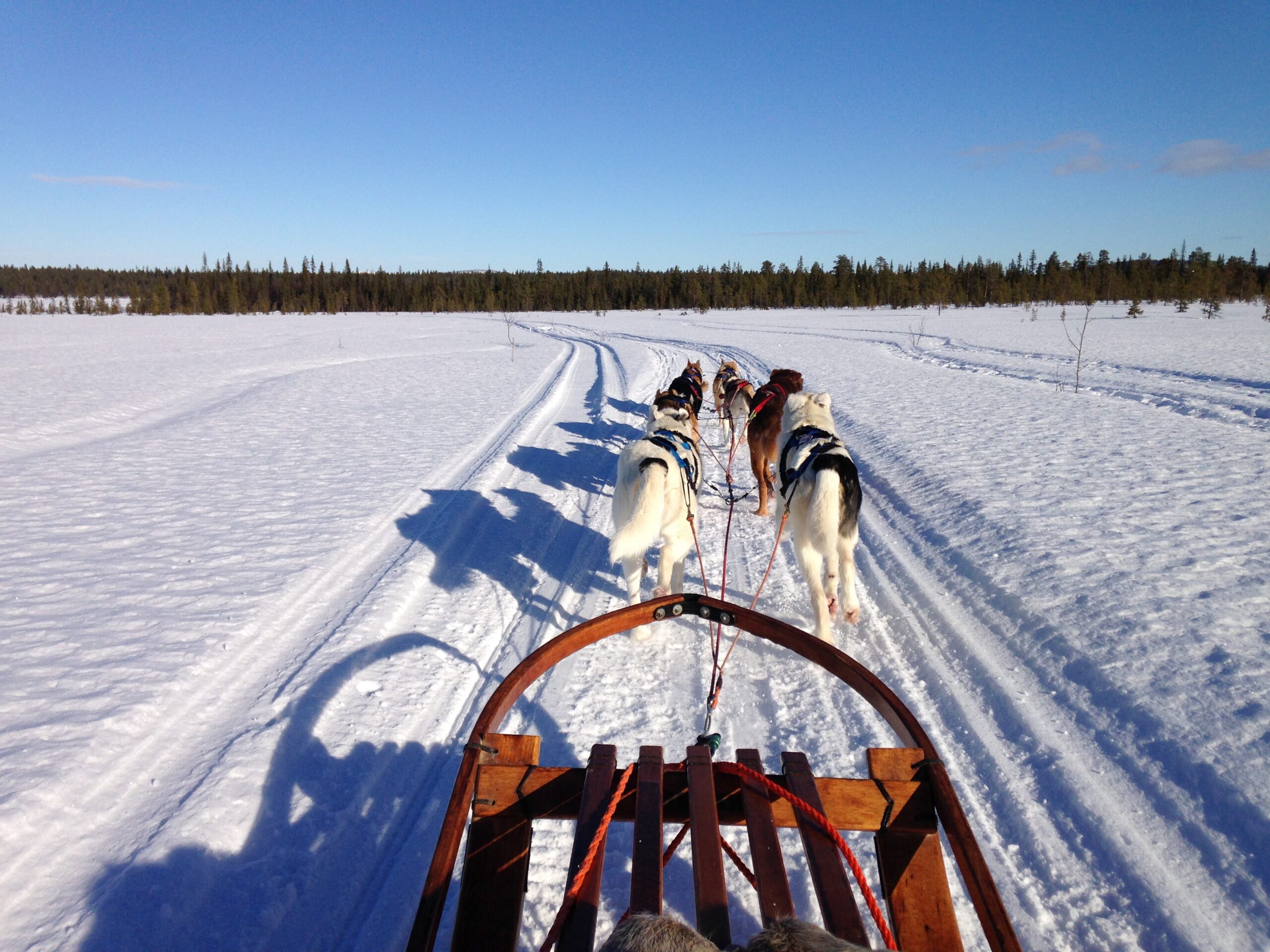
The next day we went dog-sledding.
We were surprised to discover the dogs weren’t huskies but what looked like your everyday average household pet dog.
We were chauffeured by Duke the Border Collie, Benjie the sheepdog, and Archie the elderly grey mongrel, among others. They took us across snowy fields and through thick pine forests under a perfect blue sky. And they seemed to truly love it. A truly brilliant afternoon.

Meeting Per‑Nils: Lapland’s Most Entertaining Man
The day got even better. After a two‑hour drive along icy roads, we reached the tiny Sami village of Övre Soppero, near the Finnish border.
We stayed with Per‑Nils, a man recommended by a local. I had no idea who he was, but it became clear quickly: he’s a local legend. Film crews from around the world have documented his semi‑traditional Sami lifestyle. Even Ray Mears, the British TV Survival Expert, has visited — no doubt building a four‑bedroom treehouse out of twigs, bear poo, and reindeer antlers before lunch.
After many stories and a bowl of delicious reindeer soup, Per offered us a snowmobile ride.
Health and Safety is not a concept Per subscribes to. He pointed out the throttle, the brake, told me to stay within 50 metres of him, and then blasted off into the darkness.
Trying to keep up — with Anya clinging on, on a machine twice the weight of my motorbike, in pitch‑black darkness, through six‑foot snow and across frozen lakes at 80 km/h — could only end one way.
We crashed.
After taking a bend too wide, we ended up waist‑deep in snow with the snowmobile at a 45‑degree angle. It took Per fifteen minutes to return — he’d probably crossed into Norway and cleared customs twice before realising we were missing. Eventually we got unstuck, and the rest of the ride was exhilarating… if slightly pants‑browning.

Life With the Sami
The Sami have lived across northern Sweden, Norway, Finland, and Russia for thousands of years. Around 80,000 Sami exist today, recognised by the UN as an Indigenous people with rights to protect their language and culture.
A little Health and Safety might also help protect their bloodline.
Their language belongs to the Uralic family (like Finnish, Estonian, and Hungarian) and has nine dialects. They also have over 300 words for snow. In England, we have two: fresh and sludge.
Traditionally, the Sami are reindeer herders — a tradition still alive today. Reindeer are central to everything: breeding, eating, clothing, trading, and now tourism.
So naturally, we had to get closer to these beautiful animals.

Reindeer Sleighing: What Could Possibly Go Wrong?
Per’s reindeer are wild, not bred. He lassos them young and gradually breaks them in — apparently by attaching gullible tourists to them.
For our sleigh ride, he chose a strong, slightly wild male. It’s easy to forget these cute creatures are powerful, unpredictable, and armed with enormous antlers. Watching Per attach the sleigh while the reindeer fought him off trying to escape was pure theatre, but then it dawned on us – we were to now ride that reindeer.
Per’s instructions were simple: “Just hold the rope and don’t fall off.”
Sound advice for an animal that can run 70 km/h — faster than a horse.
Within five minutes, our reindeer veered off the path and buried himself up to the neck in snow. He panicked, which made is panic. We screamed for Per but of course, nowhere in sight. Eventually, our sweating reindeer scrambled back up onto shallowing snow, and the rest of the journey went smoothly.
And that pretty much wrapped up our Lapland adventure.

Goodbye Lapland
This trip was incredible. Spending time with Per‑Nils and his wife Britt‑Marie was a rich, unforgettable experience.
Swedish Lapland — the beauty, the remoteness, the people, the reindeer, the culture, the food, the adventures — will stay with us forever.
But for now, it’s time to go home. It must’ve been love… but it’s over now.


