
If you ever want to understand Russia beyond the cities, you need to visit a village. Rural Russia is a world of its own — tough, traditional, and full of stories and characters you won’t find anywhere else.
Travelling in rural Russia
Make no mistake, Russia is massive.
Spanning halfway across Earth, across eleven time zones, and covering over 16 million square kilometres, it’s by far the largest country in the world, making the UK look like a fart in a jacuzzi in comparison.
Finding space away from the Moscow madness
It doesn’t feel spacious when you’re wrestling a granny for the last spot on the Moscow metro but there is a huge amount open space in this country.
Drive two hours from the centre of Moscow and you are greeted with forest after forest and flat green land as far as the eye can see. It really is quite refreshing.

Village life
And yes, people do live out here, in small remote villages.
When we travel, we always make a point of visiting a more rural setting because it’s more rewarding to experience what feels like, real life.
In today’s cosmopolitan cities of the World, they can often blend into one and another and feel like ‘just another city’.
Whilst many cities can offer a taste of a country’s culture, we always find escaping the city opens the door to get into the true culture.
Today, village life in Russia is tough and basic. People live in old traditional houses with basic amenities.
We visited family in a village of less than 200 inhabitants, called Dukhovo, a 5-hour drive south of Moscow.
The ‘long-drop’, nut & cherry picking and vodka, the king
Here, villagers work extremely hard to live off the land and there’s not much to do apart from life’s essentials of gathering and preparing food.
Whilst there is electricity, the shower is an outdoor tub, water is gathered from a well and the toilet is an outdoor ‘long drop’.
It’s fair to say Russian village gardens and an army of flies go hand in hand.
Vodka is king in the village and within five minutes of arrival, I had a 75ml shot glass of vodka in front of me.
Five minutes later after three 3 eye-watering gulps, the first glass was empty, and my insides were on fire with my throat feeling like I’d been guzzling paint stripper.
After twenty minutes, a whole bottle between two of us was gone.
And so, what do you do after finishing a bottle of vodka? Go for a swim in the local river of course.
The vodka clearly gave me courage to not care about the eels sharing the water with us.
Following the swim, it was time for nut and cherry picking in the local forest.
Later, the evening’s entertainment was a game of dominos.
This was entertainment back to basics and I loved it. Gone was the materialism of Moscow and this was life at its simplest- vodka, sun, nut and cherry picking, river swimming.
If fruit picking were an Olympic sport, the Russian villagers would be running out of space to store their feast of gold medals, as they take serious pride in their way of life.
But it’s not a lifestyle I could live.

The sobering reality of village life after the Soviets
It’s hard to imagine village life under the Soviets but back then things were more prosperous and the village more populous.
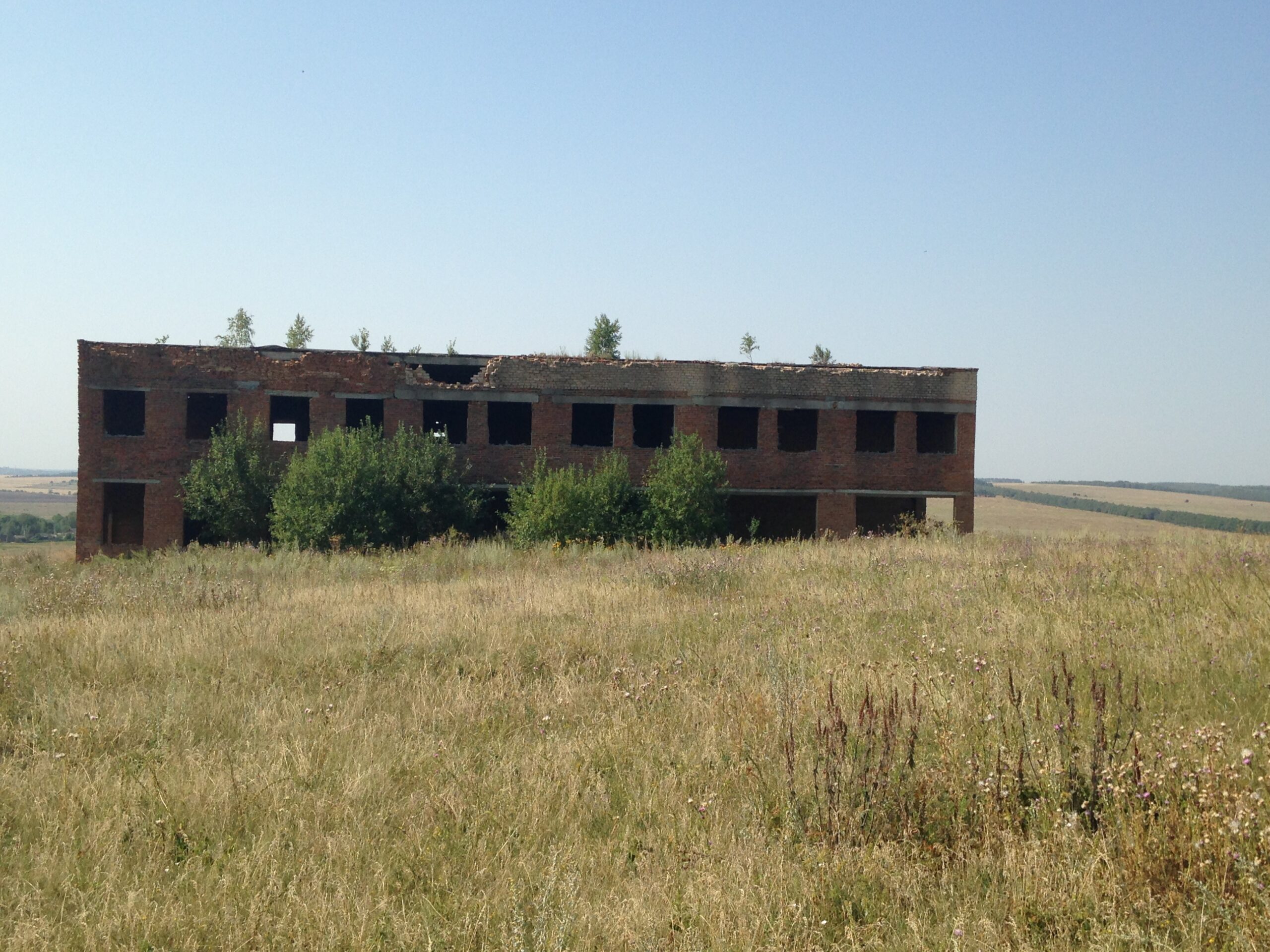
Today, the hospital is now gone, the school closed years ago, the social club no longer open, buildings are derelict and most people have fled to Moscow for work.
All that remained open was one small run-down shop, with heaps of shelves but hardly anything filling them.
The largest section of products was the Vodka section.
When we arrived here with bottles of wine as gifts, we could only open them by pushing the cork in. No one in any houses we visited owned any form of wine bottle opener as vodka is the only drink here.
We were frowned upon for bringing such a weak drink into the village.
I seemed to be the talk of the village, being the only foreigner to ever visit in recent times, and one by one the villagers came to have a glimpse.
I may as well have come from Mars such was the curiosity.
I even got hit on by a grandma a year younger than me — proof that I’ve still got it, even if my competition was mostly ducks and a drunk husband

Priceless stories of old from the babushkas
Villagers seemed more friendly than city folk, and I thoroughly enjoyed being the novelty of the village.
I met many warm, friendly, interesting people, all with a life story and sadly the majority always told the tale of some hardship.
The most interesting life story was from a seventy-nine-year-old babushka (grandma), who had lost all four of her sons (one daughter remaining) in their thirties to suicide or alcohol.
She had an incredible toughness and friendliness about her, as she walked around with what she called her ‘horse’ (her walking stick).
Another babushka, aged ninety, told of the time when the Nazis reached the village in WW2. A Nazi soldier asked her for some plates, but she misunderstood and thought he wanted veal, so she took him to her cow to show that the cow hadn’t given birth yet.
He punched her in the face.
A priceless yet sobering story.
And a reminder just how close to taking Moscow the Nazis got and that history is often hidden in these little powerful stories.
But people here seem very happy, whilst I think they recognise society’s shortcomings, for them it is everyday life and many here just cannot get their head around the lifestyle we live of visiting many countries.
Most of them have hardly been further than Moscow.
I don’t think the telephone has yet been invented yet in the village, so the Internet may as well be like something from Back to the Future.
I found it amusing how an online poem about the US President had ‘gone viral’ in the village.
Someone had handwritten it out on paper, and it was being passed from house to house. That’s the village internet!

A Soviet time warp
We reached the second, slightly larger village, after a tedious five-hour journey on some on the worst conditioned roads I’ve been on.
We stopped by the hospital to visit a sick relation. The hospital was like a time warp. A crumbling building and incredibly old equipment as if still in Soviet times.
The village itself felt much more Soviet than anywhere I’ve been in Russia, with several war memorials displaying the soviet red star and old soviet style shops, cafés and even the house numbers on the houses.The village is called Leo Tolstoy, named after Russia’s favourite son who wrote War and Peace, as it’s the spot where he died whilst travelling on a train.
There’s a small quaint museum by the station in the former house of the station master who cared for him when he fell ill.
After two days, we then headed back to Moscow.

A lesson in complex Russian society
Our time in the Russian villages has helped me stitch together a part of the complexity of Russia society I’d never seen before — the kindness, the toughness, the endless homemade food, and of course, the vodka that could strip paint.
It’s a world far from Moscow, far from modern life, and one I’ll never forget.
Next stop: Kazakhstan — and hopefully fewer flies.